
Cauliflower Nutrition Facts
A complete scientific breakdown of calories, carbs, and micronutrients in raw cauliflower.
Written by Victura Nutrition TeamReviewed by Victura Editorial ReviewLast updated Nov 14, 2026
25
Calories
1.9g
Protein
5.0g
Carbs
Generally yes
Is it healthy?
per 100g · per panel values
Track this food in VicturaQuick answer
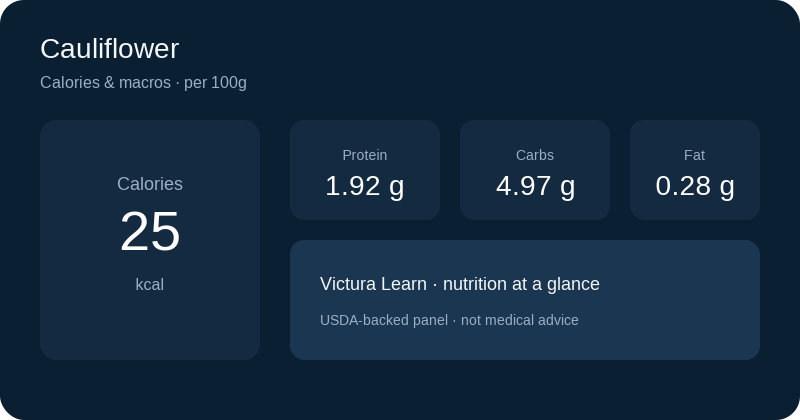
A 100g serving of cauliflower provides about 25 kcal. Per 100g you get about 4.97g carbs and 1.92g protein. Glycemic index is around 15.
Cauliflower is a whole food with approximately 25 calories per 100g, tracked in Victura for macro-aware meal logging.
- Calories (100g serving)
- 25 kcal
- Carbs (100g)
- 4.97g
- Protein (100g)
- 1.92g
- Serving reference
- 100g · 100g serving
- Glycemic index
- 15

Where the calories come from
Per 100g · protein & carbs 4 kcal/g, fat 9 kcal/g
- Protein1.9 g · 25.5%
- Carbs5 g · 66.1%
- Fat0.3 g · 8.4%
Serving calculator
How much did you eat or drink — Cauliflower?
25
Calories
1.9g
Protein
5.0g
Carbs
0.3g
Fat
Nutrition facts
per 100g · Source: USDA FoodData Central (seeded Phase 0)
25 kcal
Calories
Vitamins
- Vitamin C: 48.2mg
Minerals
- Potassium: 299mg
Scientific explanation
Research-backedCauliflower provides an exceptional array of essential nutrients while maintaining an incredibly low energy density. A standard 100g serving of raw cauliflower contains just 25 calories, 1.92 grams of protein, 0.28 grams of fat, and 4.97 grams of total carbohydrates. Of these carbohydrates, 2.0 grams come from dietary fiber, resulting in a net carbohydrate count of only 2.97 grams. This low-glycemic profile (with a Glycemic Index of 15) makes it an ideal staple for low-carbohydrate, ketogenic, and diabetic-friendly dietary patterns.
🔥 How Many Calories Does Cauliflower Have?
When planning meals, understanding portion sizes is key. While a standard 100g reference serving contains 25 calories, a typical medium head of raw cauliflower (approximately 588 grams) contains about 147 calories. This high volume-to-calorie ratio is highly beneficial for satiety and weight management, allowing individuals to consume satisfying portions without exceeding calorie limits.

💊 Micronutrient Profile: Vitamin C and Potassium
Beyond macronutrients, cauliflower is a potent source of essential vitamins and minerals. A 100g serving delivers 48.2 mg of Vitamin C, which represents 54% of the Daily Value (DV). Vitamin C is a powerful antioxidant crucial for collagen synthesis, immune function, and iron absorption. Additionally, cauliflower contains 299 mg of Potassium (6% DV) per 100g, an essential electrolyte that supports cardiovascular health, fluid balance, and muscle function.
✅ Bioactive Compounds and Health Benefits
As a member of the brassica (cruciferous) family, cauliflower is rich in glucosinolates and isothiocyanates. These sulfur-containing compounds have been extensively studied for their role in supporting cellular health and phase II detoxification enzymes in the liver. The dietary fiber in cauliflower also supports a healthy gut microbiome, promoting the growth of beneficial short-chain fatty acids (SCFAs) like butyrate, which maintain colon health.
Community insights
Community insightIn the Victura community, cauliflower has transitioned from a simple side dish to one of the most versatile culinary tools for macro-management. Anonymized meal logs indicate that cauliflower is most frequently utilized as a direct substitute for high-carbohydrate grains.
🥗 Popular Culinary Swaps
- Cauliflower Rice: By grating or pulsing raw cauliflower florets in a food processor, users create a low-calorie base for stir-fries and bowls. Swapping 150g of cooked white rice (approx. 195 calories) for 150g of cauliflower rice (approx. 38 calories) saves over 150 calories while significantly increasing fiber intake.
- Cauliflower Mash: Steamed and blended with a touch of garlic and olive oil, cauliflower serves as an excellent alternative to traditional mashed potatoes, reducing the glycemic load of the meal.
- Pizza Crusts and Baking: Ground cauliflower combined with egg or cheese is widely used to create gluten-free, keto-friendly pizza crusts.
🥗 Practical Preparation Tips
To preserve the water-soluble Vitamin C content, the Victura culinary team recommends roasting, air-frying, or quick-steaming cauliflower rather than boiling it. Boiling can cause up to 50% of the Vitamin C to leach into the cooking water. Roasting at high temperatures (400°F/200°C) caramelizes the natural sugars (1.91g per 100g), enhancing the flavor profile without adding extra calories.
Pros
Cons
Best time to eat
Good windows
Consider avoiding
Diet compatibility
Weight loss
Friendly
Consult your healthcare provider for personalized guidance.
Keto
Friendly
Consult your healthcare provider for personalized guidance.
Diabetes
Friendly
Consult your healthcare provider for personalized guidance.
Frequently asked questions
People also ask
Is a cauliflower healthy?
Yes — a cauliflower is a whole food with measurable nutrients. Healthiness depends on overall diet, portions, and your goals. Estimated GI is 15.
Can I eat a cauliflower every day?
Most people can include a cauliflower daily as part of a balanced diet, as long as total calories and carbs fit their plan.
Are Cauliflowers good for weight loss?
Cauliflowers can fit a calorie-controlled diet when portions are measured.
How many calories are in a cauliflower?
A typical medium serving of cauliflower has about 25 calories, while 100g contains about 25 calories (USDA reference).
Are Cauliflowers good before a workout?
Cauliflowers can work before activity when you want easy carbs; pair a cauliflower with protein if your session is long.
Are Cauliflowers high in sugar?
Cauliflowers contain about 1.9g sugar per 100g — mostly natural sugars when whole.
Is cauliflower healthy?
Yes — cauliflower is a nutrient-dense whole food. Its health benefits depend on your overall diet, portion sizes, and individual health goals. It has a very low estimated glycemic index of 15.
Can I eat cauliflower every day?
Most people can safely enjoy cauliflower daily as part of a balanced, varied diet, provided it fits within their daily macronutrient and caloric targets.
Is cauliflower good for weight loss?
Yes. Cauliflower is highly beneficial for weight loss due to its low calorie density (25 calories per 100g) and high water and fiber content, which promote satiety.
Is cauliflower good before a workout?
Cauliflower can be eaten before a workout, but because it is very low in fast-digesting carbohydrates and high in fiber, it is not an ideal quick-energy source. For longer sessions, pair it with a clean protein source.
Is cauliflower high in sugar?
No. Cauliflower is very low in sugar, containing only about 1.91g of natural sugars per 100g serving.
Is cauliflower keto-friendly?
Yes. With only 2.97g of net carbs per 100g serving, cauliflower is highly keto-friendly and widely used as a low-carb substitute for grains and potatoes.
How we review this guide
- Written by
- Victura Nutrition Team
- Reviewed by
- Victura Editorial Review
- Reference sources
- 4
- Last updated
- Nov 14, 2026
References
Ready to track your meals with AI?
Victura scans your plate, logs macros automatically, and coaches you toward your goals — halal, keto, diabetic-friendly, and more.