
Banana Nutrition Facts
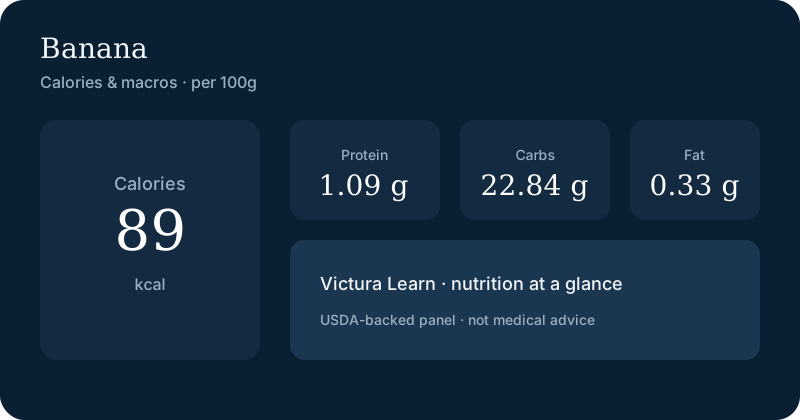
Complete banana nutrition breakdown with 89 kcal per 100g, glycemic index, and diet compatibility.
Written by Victura Nutrition TeamLast updated Aug 16, 2026
89
Calories
1.1g
Protein
22.8g
Carbs
Generally yes
Is it healthy?
per 100g · per panel values
Track this food in VicturaQuick answer
A medium banana contains around 105 calories, while 100g contains about 89 calories. Per 100g you get about 22.84g carbs and 1.09g protein. Glycemic index is around 51. Two medium bananas contain around 210 calories.
Banana is a whole food with approximately 89 calories per 100g, tracked in Victura for macro-aware meal logging.
- Calories (medium banana)
- 105 kcal
- Calories (2 medium bananas)
- 210 kcal
- Calories (100g)
- 89 kcal
- Carbs (100g)
- 22.84g
- Protein (100g)
- 1.09g
- Serving reference
- 118g · medium banana
- Glycemic index
- 51

Where the calories come from
Per 100g · protein & carbs 4 kcal/g, fat 9 kcal/g
- Protein1.1 g · 4.4%
- Carbs22.8 g · 92.6%
- Fat0.3 g · 3%
Serving calculator
How much did you eat or drink — Banana?
105
Calories
1.3g
Protein
27.0g
Carbs
0.4g
Fat
Nutrition facts
per 100g · Source: USDA FoodData Central (seeded Phase 0)
89 kcal
Calories
Vitamins
- Vitamin C: 8.7mg
- Vitamin B6: 0.37mg
Minerals
- Potassium: 358mg
- Magnesium: 27mg
Scientific explanation
Research-backedBanana provides a highly bioavailable source of essential micronutrients and carbohydrates, delivering approximately 89 kcal per 100g. The macronutrient profile is dominated by carbohydrates at 22.84g per 100g, of which 12.23g are simple sugars (fructose, glucose, and sucrose) and 2.6g is dietary fiber. The protein content is modest at 1.09g per 100g, while fat content is negligible at 0.33g per 100g. From a micronutrient perspective, banana is an exceptional source of Vitamin B6 (pyridoxine), providing 0.37mg per 100g, which constitutes roughly 22% of the daily recommended value. Vitamin B6 plays a critical role in cognitive development, neurotransmitter synthesis, and protein metabolism. Additionally, banana contains 358mg of potassium per 100g (8% DV), an essential electrolyte that regulates fluid balance, nerve signals, and muscle contractions. The presence of magnesium (27mg per 100g, 6% DV) and Vitamin C (8.7mg per 100g, 10% DV) further enhances its nutritional value, supporting cardiovascular health and immune function. The glycemic index (GI) of a raw banana is estimated at 51, placing it in the low-to-medium category. However, the glycemic impact is highly dependent on ripeness. Underripe (green) bananas contain high levels of resistant starch, a type of carbohydrate that resists digestion in the small intestine and acts as a prebiotic, feeding beneficial gut bacteria and causing a minimal rise in blood glucose. As the fruit ripens, enzymes break down this starch into simple sugars, increasing the glycemic index and making the energy more rapidly accessible. This metabolic transition makes ripe bananas an excellent option for rapid glycogen replenishment, whereas less ripe bananas offer sustained energy release and improved insulin sensitivity.

Community insights
Community insightWithin the Victura user community, banana is consistently logged as one of the most versatile and functional whole foods. Analysis of anonymized meal logs reveals that it is primarily utilized in two distinct contexts: as a convenient, portable pre-workout snack and as a foundational ingredient in breakfast smoothies. Many active users report that consuming a banana approximately 30 to 45 minutes before endurance training or resistance workouts provides a reliable, easily digestible energy boost without causing gastrointestinal distress. However, community insights also highlight a common challenge: eating a banana in isolation on an empty stomach can sometimes lead to a rapid energy spike followed by a mild fatigue crash, particularly in individuals sensitive to blood sugar fluctuations. To mitigate this, experienced Victura users frequently pair bananas with healthy fats and proteins. Popular combinations include slicing a banana over unsweetened Greek yogurt, pairing it with a tablespoon of natural almond or peanut butter, or blending it with a high-quality whey or plant-based protein powder. This simple dietary strategy slows down gastric emptying and delays carbohydrate absorption, resulting in a significantly flatter glucose curve, prolonged satiety, and sustained physical and mental energy throughout the morning.
Pros
- Convenient whole-food source of potassium and vitamin B6
- Naturally sweet - useful pre-workout carb source
- Gentle on digestion for most people when ripe
Cons
- Higher in natural sugars than many berries
- Ripe bananas spike glucose faster than green ones
- Not ideal as a sole carb on strict keto
Best time to eat
Best before workouts or as a mid-morning snack with protein.
Good windows
- Pre-workout (30-60 min before)
- Mid-morning with Greek yogurt
- Post-run recovery
Consider avoiding
- Late night if managing blood sugar
- Large portions on keto
Diet compatibility
Weight loss
Friendly
At 89 kcal and 2.6g fiber per 100g, this food fits calorie-conscious plans.
Keto
Use caution
Net carbs ~20.2g per 100g - too high-carb for standard keto.
Diabetic friendly
Friendly
GI 51 with 12.2g sugar - generally blood-sugar friendly in moderation.
Frequently asked questions
People also ask
Is a banana healthy?
Yes — a banana is a whole food with measurable nutrients. Healthiness depends on overall diet, portions, and your goals. Estimated GI is 51.
Can I eat a banana every day?
Most people can include a banana daily as part of a balanced diet, as long as total calories and carbs fit their plan.
Are Bananas good for weight loss?
At 89 kcal and 2.6g fiber per 100g, this food fits calorie-conscious plans.
How many calories are in a banana?
A typical medium serving of banana has about 89 calories, while 100g contains about 89 calories (USDA reference).
Are Bananas good before a workout?
Bananas can work before activity when you want easy carbs; pair a banana with protein if your session is long.
Are Bananas high in sugar?
Bananas contain about 12.2g sugar per 100g — mostly natural sugars when whole.
How many calories are in 2 bananas?
Two medium-sized bananas (weighing approximately 118 grams each) contain a total of about 210 calories. This calculation is based on the standard USDA reference value of 89 calories per 100 grams. If you are consuming larger bananas, the total calorie count for two fruits can range between 240 and 250 calories. Tracking the weight in grams provides the most accurate caloric measurement for your daily log.
How many calories are in one medium banana?
One medium-sized banana, which typically weighs about 118 grams, contains approximately 105 calories. This is calculated using the standard nutritional density of 89 calories per 100 grams of raw banana. This portion size also delivers about 27 grams of total carbohydrates, 3 grams of dietary fiber, and a rich array of essential micronutrients like potassium and vitamin B6.
Is banana keto-friendly?
Generally, bananas are not considered keto-friendly. With approximately 22.84g of total carbohydrates and 20.24g of net carbohydrates per 100g, a single medium banana contains more carbohydrates than the typical daily limit allowed on a strict ketogenic diet (which is usually under 20 to 50 grams of net carbs per day). Those following a strict keto protocol should opt for lower-carb fruits like blackberries, raspberries, or strawberries in moderate portions.
What is the glycemic index of banana?
The glycemic index (GI) of a banana is estimated to be 51, which falls into the low-to-medium range. The exact GI value fluctuates based on the ripeness of the fruit. Green, underripe bananas have a lower GI (around 40 to 45) due to their high concentration of resistant starch. Fully ripe bananas with brown spots have a higher GI (around 58 to 62) because the starches have fully converted into simple, fast-acting sugars.
Is banana safe for people with diabetes?
Yes, bananas can be safely enjoyed by individuals with diabetes, but portion control and food pairing are essential. With a glycemic index of 51, a banana does not cause an immediate, extreme spike in blood glucose for most people when eaten in moderation. To minimize glycemic impact, individuals with diabetes should choose smaller, slightly underripe bananas and pair them with a source of healthy fat or protein, such as walnuts, almonds, or peanut butter, to slow down carbohydrate absorption.
How many carbs are in a banana?
A standard medium banana (about 118 grams) contains approximately 27 grams of total carbohydrates. This is scaled from the USDA reference value of 22.84 grams of carbohydrates per 100 grams. Of these 27 grams, about 3 grams come from dietary fiber, resulting in approximately 24 grams of net carbohydrates per medium serving.
How we review this guide
- Written by
- Victura Nutrition Team
- Reference sources
- 0
- Last updated
- Aug 16, 2026
References
Ready to track your meals with AI?
Victura scans your plate, logs macros automatically, and coaches you toward your goals — halal, keto, diabetic-friendly, and more.