
Feta Nutrition Facts
Evidence-based feta nutrition: 264 kcal per 100g, macros, benefits, risks, glycemic context, and diet fit.
Written by Victura Nutrition TeamReviewed by Victura Editorial ReviewLast updated Nov 14, 2026
264
Calories
14.2g
Protein
4.1g
Carbs
Use caution
Is it healthy?
per 100g · per panel values
Track this food in VicturaQuick answer
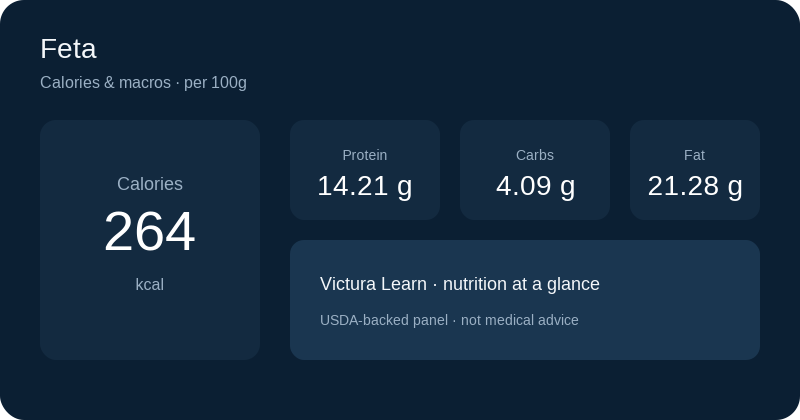
A 100g serving of feta provides about 264 kcal. Per 100g you get about 4.09g carbs and 14.21g protein.
Feta is a whole food with approximately 264 calories per 100g, tracked in Victura for macro-aware meal logging.
- Calories (100g serving)
- 264 kcal
- Carbs (100g)
- 4.09g
- Protein (100g)
- 14.21g
- Serving reference
- 100g · 100g serving

Where the calories come from
Per 100g · protein & carbs 4 kcal/g, fat 9 kcal/g
- Protein14.2 g · 21.5%
- Carbs4.1 g · 6.2%
- Fat21.3 g · 72.3%
Serving calculator
How much did you eat or drink — Feta?
264
Calories
14.2g
Protein
4.1g
Carbs
21.3g
Fat
Nutrition facts
per 100g · Source: USDA FoodData Central (seeded Phase 0)
264 kcal
Calories
Vitamins
- Vitamin B12: 1.69mcg
Minerals
- Calcium: 493mg
Scientific explanation
Research-backed🥗 Feta at a glance
Feta provides 264 calories per 100 g (3.5 oz), along with 14.2 g protein, 21.3 g fat, 4.1 g carbs, and 0 g fiber. Few people eat a full 100 g block in one sitting, so the table below also scales those USDA values to a realistic 1 oz (28 g) crumble. Every number traces to the USDA FoodData Central record 173420 for "Cheese, feta."
| Nutrient | Per 1 oz (28 g) | Per 100 g (3.5 oz) |
|---|---|---|
| Calories | 74 kcal | 264 kcal |
| Protein | 4.0 g | 14.2 g |
| Carbohydrate | 1.1 g | 4.1 g |
| Fat | 6.0 g | 21.3 g |
| Fiber | 0.0 g | 0.0 g |
| Sugar | 1.1 g | 4.1 g |
Key takeaway: Feta is an energy-dense cheese — a 1 oz (28 g) crumble adds roughly 74 calories and 6 g of fat, while a 1/4 cup (38 g) scoop lands near 100 calories.
💪 Protein and fat in feta
Feta is roughly one-fifth fat by weight and about 14% protein, which is typical for a brined sheep's- or cow's-milk cheese. One ounce (28 g) delivers 4.0 g protein — modest next to chicken breast or Greek yogurt, but genuinely useful when scattered over a salad, eggs, or roasted vegetables. Fat is the dominant macronutrient at 21.3 g per 100 g (6.0 g per ounce), and much of it is saturated, so feta works best as a flavoring rather than as your protein anchor for the meal.
- 1 tbsp crumbled (about 6 g): ~16 kcal, 0.9 g protein, 1.3 g fat
- 2 tbsp crumbled (about 12 g): ~32 kcal, 1.7 g protein, 2.6 g fat
- 1 oz (28 g): ~74 kcal, 4.0 g protein, 6.0 g fat
- 1/4 cup crumbled (about 38 g): ~100 kcal, 5.4 g protein, 8.1 g fat
- 100 g (3.5 oz): 264 kcal, 14.2 g protein, 21.3 g fat
💊 Calcium, B12, and micronutrients
A 100 g portion supplies 493 mg calcium — 38% of the Daily Value — plus 1.69 mcg vitamin B12, about 70% of the DV. Scaled to a realistic 1 oz (28 g) serving, that is roughly 138 mg calcium (11% DV) and 0.47 mcg B12 (20% DV). Those two nutrients are the clearest reason to keep feta in rotation, particularly for dairy-eating vegetarians who want a concentrated calcium source without a large portion.

🍞 Carbs, sugar, and glycemic index
Feta carries only 4.1 g carbohydrate per 100 g, and the panel lists the same 4.1 g as sugar — milk lactose rather than added sugar. No glycemic index is published for feta, and with carbohydrate this low the GI has little practical meaning for blood-sugar response. A 1 oz (28 g) portion contributes about 1.1 g sugar, which is negligible in most eating plans, including low-carb and keto patterns where net carbs stay near 4.1 g per 100 g.
🥄 Brine, salt, and portion control
Feta is traditionally packed in brine, so it brings salt as well as richness to a dish; the panel used here reports macronutrients and the listed vitamins and minerals only. Because fat and calories concentrate fast, weigh or spoon it rather than pouring freely from the container. Crumbling instead of slicing spreads a smaller amount across more surface area, so 1 oz (28 g) reads as a generous topping.
🥗 Putting feta on the plate
- Crumble 1 oz (28 g) over a lunch salad in place of creamy dressing.
- Fold 1/4 cup (38 g) into a three-egg omelet for roughly 100 extra calories.
- Finish roasted vegetables with 2 tbsp (12 g) and a squeeze of lemon.
- Pair 1 oz (28 g) with cucumber and olives for a snack plate under 200 calories.
- Use feta in place of higher-fat melting cheeses when you want a salty, sharp note.
Community insights
Community insight🍽️ How members actually eat feta
Among anonymized Victura meal logs, feta appears most often as a finishing ingredient rather than a main protein. Members crumble about 1 oz (28 g) over a lunch salad, fold 1/4 cup (38 g) into an omelet, or scatter a couple of tablespoons (12 g) across roasted vegetables. Logging it by weight instead of by "sprinkle" is the single habit that separates members who stay inside their calorie targets from those who drift.
- Salad topper: 1 oz (28 g) crumbled, about 74 calories
- Omelet filling: 1/4 cup (38 g), about 100 calories
- Grain bowl finish: 2 tbsp (12 g), about 32 calories
- Snack plate: 1 oz (28 g) with cucumber and olives
🍽️ Pairings members reach for
Feta's salt and acidity make it a natural match for sweet and earthy foods. In logged meals it shows up most with watermelon and mint, roasted beets, lentils, cherry tomatoes, eggs, and oregano with olive oil. Members who treat it as a seasoning — a small amount against a large volume of vegetables or legumes — report the meal feels richer without a big calorie jump.
🥗 What members report
Members who pair feta with a protein and a fiber source, such as lentils, eggs, or a large salad, describe steadier energy than eating it alone on an empty stomach. These are self-reported usage patterns from Tier 4 meal logs, not clinical findings, and they should be read as practical meal-building hints. Portion size remains the variable that matters most for calorie goals.
🥗 Buying and storing
Blocks keep better than pre-crumbled tubs, and brine-packed feta holds for weeks in the refrigerator once opened. Members who buy crumbles tend to use more per sitting because the pieces are already small, so a block and a fork often stretches further across the week.
Pros
- Whole cheese with measurable macronutrients and no added sugar
- High in calcium (493 mg, 38% DV) and vitamin B12 (1.69 mcg, 70% DV) per 100 g
- Only 4.1 g carbohydrate per 100 g — fits low-carb and keto patterns
- Strong flavor means a small 1 oz (28 g) portion goes a long way
Cons
- Energy-dense at 264 kcal and 21.3 g fat per 100 g — portions add up fast
- Contains 0 g fiber, so it cannot anchor a meal on its own
- Brine-packed feta contributes salt, which matters for some eating plans
Best time to eat
Pair with protein and fiber for balanced meals; keep portions near 1 oz (28 g).
Good windows
- With main meals
- As a flavoring over salads and vegetables
Consider avoiding
- Very large portions without activity
- Eating a large portion alone as a pre-workout snack
Diet compatibility
Weight loss
Use caution
At 264 kcal and 0.0g fiber per 100g, this food is energy-dense - watch portions.
Keto
Friendly
Net carbs ~4.1g per 100g - compatible with strict keto.
Diabetic friendly
Friendly
GI N/A with 4.1g sugar - generally blood-sugar friendly in moderation.
Frequently asked questions
People also ask
Is a feta healthy?
Yes — a feta is a whole food with measurable nutrients. Healthiness depends on overall diet, portions, and your goals.
Can I eat a feta every day?
Most people can include a feta daily as part of a balanced diet, as long as total calories and carbs fit their plan.
Are Fetas good for weight loss?
At 264 kcal and 0.0g fiber per 100g, this food is energy-dense - watch portions.
How many calories are in a feta?
A typical medium serving of feta has about 264 calories, while 100g contains about 264 calories (USDA reference).
Are Fetas good before a workout?
Fetas can work before activity when you want easy carbs; pair a feta with protein if your session is long.
Are Fetas high in sugar?
Fetas contain about 4.1g sugar per 100g — mostly natural sugars when whole.
How much protein is in feta per 100g?
Feta provides 14.2g protein per 100g, or about 4.0g per 1 oz (28g) crumble, per USDA FoodData Central.
Is feta keto-friendly?
Yes — feta has only 4.1g carbs per 100g and no fiber, so net carbs stay near 4.1g, fitting strict keto and low-carb patterns in measured portions.
How much calcium is in feta?
Feta supplies 493mg calcium per 100g (38% DV), or roughly 138mg (11% DV) per 1 oz (28g) serving.
Does feta have a glycemic index?
No glycemic index is published for feta; with only 4.1g carbs per 100g, GI has little practical meaning for blood-sugar response.
How we review this guide
- Written by
- Victura Nutrition Team
- Reviewed by
- Victura Editorial Review
- Reference sources
- 4
- Last updated
- Nov 14, 2026
References
Ready to track your meals with AI?
Victura scans your plate, logs macros automatically, and coaches you toward your goals — halal, keto, diabetic-friendly, and more.