
Almond Milk Nutrition Facts
Calories, protein, carbs, calcium, and practical ways to use unsweetened almond milk
Written by Victura Nutrition TeamReviewed by Victura Editorial ReviewLast updated Nov 11, 2026
15
Calories
0.4g
Protein
0.6g
Carbs
Generally yes
Is it healthy?
per 100g · per panel values
Track this food in VicturaQuick answer
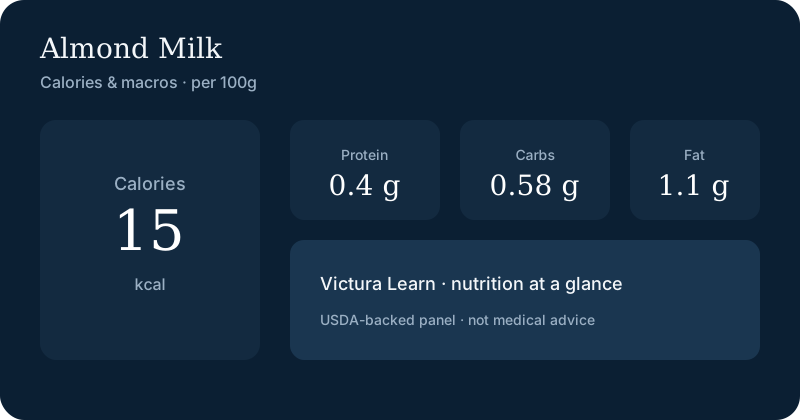
A cup of almond milk contains around 36 calories, while 100g contains about 15 calories. Per 100g you get about 0.58g carbs and 0.4g protein.
Almond Milk is a whole food with approximately 15 calories per 100g, tracked in Victura for macro-aware meal logging.
- Calories (cup)
- 36 kcal
- Calories (100g)
- 15 kcal
- Carbs (100g)
- 0.58g
- Protein (100g)
- 0.4g
- Serving reference
- 240g · cup
Key takeaways
- Unsweetened almond milk has about 36 calories per cup and 15 calories per 100 g.
- It is low in protein and fiber, so pair it with protein- and fiber-rich foods.
- Calcium and vitamin E appear on the USDA panel, but fortification varies by brand.
- Sweetened and flavored almond milk can add sugar, so choose unsweetened when possible.

Where the calories come from
Per 100g · protein & carbs 4 kcal/g, fat 9 kcal/g
- Protein0.4 g · 11.6%
- Carbs0.6 g · 16.8%
- Fat1.1 g · 71.6%
Serving calculator
How much did you eat or drink — Almond Milk?
15
Calories
0.4g
Protein
0.6g
Carbs
1.1g
Fat
Nutrition facts
per 100g · Source: USDA FoodData Central (seeded Phase 0)
15 kcal
Calories
Vitamins
- Vitamin E: 2.81mg
Minerals
- Calcium: 188mg
Scientific explanation
Research-backed🥛 Quick answer
Unsweetened, shelf-stable almond milk provides about 36 calories per 1 cup (240 g; 8 fl oz), calculated from the USDA value of 15 kcal per 100 g. Per 100 g it supplies 15 calories, 0.4 g protein, 0.58 g carbs, 1.1 g fat, 0.2 g fiber, and 0 g sugar. These figures describe the unsweetened product; sweetened, vanilla, chocolate, and barista-style versions can be higher in sugar and calories, so check the label.
| Nutrient | Per 100 g (3.5 oz) | Per 1 cup (240 g; 8 fl oz) |
|---|---|---|
| Calories | 15 kcal | 36 kcal |
| Protein | 0.4 g | 0.96 g |
| Carbs | 0.58 g | 1.39 g |
| Fat | 1.1 g | 2.64 g |
| Fiber | 0.2 g | 0.48 g |
| Sugar | 0.0 g | 0.0 g |
Key takeaway: Unsweetened almond milk is a low-calorie, low-sugar drink with calcium and vitamin E on the USDA panel, but it is not a protein substitute for dairy or soy milk, and it is not suitable for people with almond or tree nut allergy.
🔥 Calories, fat, and carbs
Most of almond milk's volume is water, which is why the calorie count stays low. The USDA panel lists 1.1 g fat, 0.58 g carbs, and 0.2 g fiber per 100 g, which works out to about 36 calories and 2.64 g fat per 1-cup pour (240 g; 8 fl oz). Net carbs — total carbs minus fiber — are roughly 0.4 g per 100 g.
- Calories: 15 kcal per 100 g; about 36 kcal per cup.
- Fat: 1.1 g per 100 g; about 2.64 g per cup.
- Carbs: 0.58 g per 100 g; about 1.39 g per cup.
- Fiber: 0.2 g per 100 g; about 0.48 g per cup.
💪 Protein and sugar
Almond milk is not a protein food. At 0.4 g protein per 100 g — about 0.96 g per cup — it contributes little toward daily protein needs, so meals built around it should include eggs, yogurt, tofu, beans, or another protein source. This unsweetened product lists 0 g sugar per 100 g; vanilla, chocolate, and barista versions often add sugar, so compare the "added sugars" line. For a higher-protein plant milk, see our soy milk nutrition page.
💊 Calcium, vitamin E, and fortification
The USDA panel lists 188 mg calcium (14% DV) and 2.81 mg vitamin E (19% DV) per 100 g — about 451 mg calcium and 6.74 mg vitamin E per cup (240 g; 8 fl oz). These values are specific to the tested product: many commercial almond milks are fortified, and levels of calcium, vitamin D, and vitamin B12 vary between brands, so treat the numbers as a reference point rather than a guarantee. Shake the carton before pouring, since added minerals can settle.
- Calcium: 188 mg per 100 g; about 451 mg per cup.
- Vitamin E: 2.81 mg per 100 g; about 6.74 mg per cup.
- Fortification: check the carton for calcium, vitamin D, and vitamin B12 if almond milk replaces dairy in your diet.

🍞 Weight loss, blood sugar, and keto
Unsweetened almond milk is low in calories, but it is not a high-protein or high-fiber drink, so it is better used as a swap for higher-calorie drinks than as a hunger-control food. Sweetened and flavored cartons can add sugar back and work against a calorie deficit.
- Weight loss: useful for calorie control; portions still count.
- Blood sugar: 0 g sugar and about 0.58 g carbs per 100 g in the unsweetened product; no glycemic index value is listed for this USDA entry.
- Keto: about 0.4 g net carbs per 100 g (0.9 g per cup), compatible with low-carb patterns.
- Diabetes: unsweetened versions are generally low in sugar; individual guidance belongs with a clinician or dietitian.
🥛 How to choose and use almond milk
Choose "unsweetened" when you want the lowest sugar and calorie option, and choose a fortified carton if almond milk is your main dairy alternative. It works in coffee, cereal, oatmeal, smoothies, and baking, but add protein and fiber foods separately — compare options on our plant-based milk pages, such as oat milk, and check how a cup fits your day with the Victura calorie calculator.
- Check the label for "unsweetened" rather than "original" or "vanilla."
- Compare added sugar, especially in chocolate and barista versions.
- Choose fortified cartons if calcium and vitamin D matter to you.
- Measure 1 cup (240 g; 8 fl oz) for consistent tracking.
⚠️ Allergy and safety
Almond milk is made from almonds, a tree nut, so people with almond or tree nut allergy should avoid it rather than rely on cross-contact warnings. It is also not a substitute for breast milk or infant formula; parents should get advice from a pediatric clinician before using it for young children.
Community insights
Community insight🥛 Where it fits in daily routines
Victura meal-log patterns show almond milk most often appearing with coffee, cereal, oatmeal, and smoothies. People frequently choose unsweetened versions when they want a dairy-free pour without added sugar. It is rarely logged as a main protein source, so it works best alongside eggs, yogurt, tofu, beans, or protein powder.
🥛 Coffee, cereal, and smoothie use
- Coffee and tea: add 2 tbsp (30 g; 1 fl oz) at a time to reduce curdling in acidic drinks.
- Cereal and oatmeal: use 1 cup (240 g; 8 fl oz) as a typical pour.
- Smoothies: use 1 cup (240 g; 8 fl oz) as a liquid base, then add protein and fiber foods.
- Baking: replace dairy milk with 1 cup (240 g; 8 fl oz) in many recipes, but expect a thinner texture.
🥛 Shopping and label habits
- Start with "unsweetened" if sugar and calories are your priority.
- Check "added sugars" on vanilla, chocolate, and barista-style cartons.
- Look for calcium, vitamin D, and vitamin B12 on fortified versions.
- Compare protein only if you plan to use almond milk as a dairy substitute — soy milk is a higher-protein option.
- Keep shelf-stable cartons for pantry use and refrigerated cartons for everyday pouring.
🥛 Common questions from the community
A common question is whether almond milk is "healthy" or "mostly water." The answer depends on fortification and added sugar, not the word almond alone.
Another common question is whether it can replace cow's milk cup for cup. Fortified almond milk can help with calcium and vitamin D, but it is not a protein equivalent, so adjust the rest of the meal. Our calorie calculator shows how a cup fits a daily target.
Pros
Cons
Best time to eat
Good windows
Consider avoiding
Diet compatibility
Weight loss
Friendly
Consult your healthcare provider for personalized guidance.
Keto
Friendly
Consult your healthcare provider for personalized guidance.
Diabetes
Friendly
Consult your healthcare provider for personalized guidance.
Frequently asked questions
People also ask
Is almond milk healthy?
Yes — almond milk is a whole food with measurable nutrients. Healthiness depends on overall diet, portions, and your goals.
Can I eat almond milk every day?
Most people can include almond milk daily as part of a balanced diet, as long as total calories and carbs fit their plan.
Are almond milk good for weight loss?
Almond milk can fit a calorie-controlled diet when portions are measured.
How many calories are in almond milk?
A typical medium serving of almond milk has about 15 calories, while 100g contains about 15 calories (USDA reference).
Are almond milk good before a workout?
Almond milk can work before activity when you want easy carbs; pair almond milk with protein if your session is long.
Are almond milk high in sugar?
Almond milk contain about 0.0g sugar per 100g — mostly natural sugars when whole.
Does almond milk have protein?
Very little: 0.4 g per 100 g, or about 0.96 g per cup. That is far less than dairy milk or soy milk, so treat it as a low-protein drink and get protein from other foods in the same meal.
Is almond milk high in sugar?
Unsweetened almond milk lists 0 g sugar per 100 g in the USDA panel. Vanilla, chocolate, and barista-style cartons often contain added sugar, so compare the "added sugars" line on the label.
Is almond milk good for weight loss?
It can help when it replaces higher-calorie drinks, since a cup has about 36 calories. It is not a filling food on its own because it is low in protein and fiber, and sweetened versions add sugar back into your day.
Can you drink almond milk every day?
Yes — unsweetened almond milk can fit a daily diet for most people. If it replaces dairy, choose a fortified carton for calcium, vitamin D, and vitamin B12 (this USDA entry lists 188 mg calcium per 100 g, and fortification varies by brand), and get protein from other sources.
Is almond milk dairy-free?
Yes. Plain almond milk contains no dairy, so it suits people avoiding lactose or milk protein. It is not tree-nut-free, however — it is made from almonds, so anyone with an almond or tree nut allergy should avoid it.
Is almond milk good before a workout?
It is mostly water with very little carbohydrate (about 1.4 g per cup) or protein (about 1 g per cup), so it works as a light liquid but not as fuel on its own. For longer or harder sessions, pair it with a carb source and a protein source.
How we review this guide
- Written by
- Victura Nutrition Team
- Reviewed by
- Victura Editorial Review
- Reference sources
- 7
- Last updated
- Nov 11, 2026
References
- Beverages, almond milk, unsweetened, shelf stable — FoodData Central(usda)
- Calcium — Consumer Fact Sheet(nih_ods)
- Vitamin E — Consumer Fact Sheet(nih_ods)
- PubMed literature search: plant-based milk alternatives, nutrition, and health(pubmed)
- Victura anonymized meal logs — plant-based milk usage patterns(victura)
Ready to track your meals with AI?
Victura scans your plate, logs macros automatically, and coaches you toward your goals — halal, keto, diabetic-friendly, and more.