
Rice Vs Quinoa Nutrition Facts
A complete scientific comparison of macronutrients, glycemic index, and micronutrient density to optimize your dietary choices.
Written by Victura Nutrition TeamReviewed by Victura Editorial ReviewLast updated Aug 8, 2026
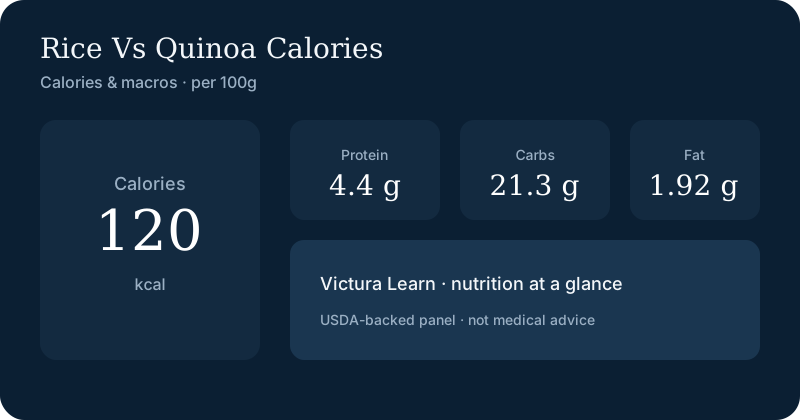
120
Calories
4.4g
Protein
21.3g
Carbs
Generally yes
Is it healthy?
per 100g · per panel values
Track this food in VicturaQuick answer
A 100g serving of rice vs quinoa provides about 120 kcal. Per 100g you get about 21.3g carbs and 4.4g protein. Glycemic index is around 53.
Rice Vs Quinoa is a whole food with approximately 120 calories per 100g, tracked in Victura for macro-aware meal logging.
- Calories (100g serving)
- 120 kcal
- Carbs (100g)
- 21.3g
- Protein (100g)
- 4.4g
- Serving reference
- 100g · 100g serving
- Glycemic index
- 53


Serving calculator
How much did you eat or drink — Rice Vs Quinoa?
120
Calories
4.4g
Protein
21.3g
Carbs
1.9g
Fat
Nutrition facts
per 100g · Source: USDA FoodData Central
120 kcal
Calories
Minerals
- Iron: 4.57mg
Scientific explanation
Research-backedRice Vs Quinoa provides an excellent case study in how structural differences between cereal grains and pseudocereals impact human nutrition. While white and brown rice are true cereal grains belonging to the Poaceae family, quinoa is a pseudocereal from the Amaranthaceae family, closely related to spinach and beets. This botanical distinction explains why their macronutrient and micronutrient profiles differ so significantly. ### Macronutrient Profiles and Protein Quality When comparing macronutrients per 100g of cooked product, quinoa contains 120 calories, 4.4g of protein, 1.92g of fat, and 21.3g of carbohydrates (including 2.8g of dietary fiber and 0.87g of sugar). In contrast, cooked white rice provides approximately 130 calories, 2.7g of protein, 0.3g of fat, and 28g of carbohydrates with a negligible 0.4g of fiber. Cooked brown rice offers 112 calories, 2.6g of protein, 0.9g of fat, and 23g of carbohydrates with 1.8g of fiber. Quinoa's primary advantage lies in its protein quality. It is one of the few plant foods that is a complete protein, meaning it contains all nine essential amino acids in balanced proportions. Rice, on the other hand, is limiting in the essential amino acid lysine, requiring pairing with legumes (like beans) to form a complete protein profile. ### Glycemic Index and Blood Sugar Regulation For individuals managing diabetes or insulin sensitivity, the glycemic index (GI) is a critical metric. Quinoa has a glycemic index of 53, placing it in the low-to-medium category. This is supported by its 2.8g of fiber per 100g, which slows down glucose absorption in the bloodstream. White rice has a high glycemic index (typically 70 to 72), causing rapid blood sugar spikes. Brown rice performs better with a GI of 50 to 55, but still lacks the protein density of quinoa to help buffer insulin responses. ### Micronutrient Density Quinoa significantly outperforms both white and brown rice in mineral content. Most notably, cooked quinoa provides 4.57 mg of iron per 100g, which satisfies 25% of the daily value (DV) for this essential mineral. White rice provides only about 1.2 mg (7% DV), and brown rice contains a mere 0.5 mg (3% DV). Quinoa is also rich in magnesium, phosphorus, and folate, making it a highly nutrient-dense option.
Community insights
Community insightIn the Victura community, meal logs reveal distinct patterns in how users incorporate these two staples. Athletes and bodybuilders frequently log white rice in their post-workout windows due to its rapid digestibility and quick glycogen replenishment capabilities. Conversely, users focused on fat loss, satiety, and long-term energy stability favor quinoa. From a culinary perspective, quinoa offers a nutty flavor and a slightly fluffy, delicate crunch, making it an excellent base for cold salads, grain bowls, and breakfast porridges. However, some users report a bitter taste if quinoa is not thoroughly rinsed before cooking; this bitterness is caused by saponins, naturally occurring chemical compounds that act as the plant's defense mechanism. Rice remains the global standard for culinary versatility, absorbing flavors exceptionally well in dishes like risottos, stir-fries, and curries. For those looking to optimize their nutrition without sacrificing the texture of rice, the Victura community often recommends a 50/50 blend of brown rice and quinoa.
Pros
Cons
Best time to eat
Good windows
Consider avoiding
Diet compatibility
Weight loss
Friendly
Consult your healthcare provider for personalized guidance.
Keto
Friendly
Consult your healthcare provider for personalized guidance.
Diabetes
Friendly
Consult your healthcare provider for personalized guidance.
Frequently asked questions
People also ask
Is a rice vs quinoa healthy?
Yes — a rice vs quinoa is a whole food with measurable nutrients. Healthiness depends on overall diet, portions, and your goals. Estimated GI is 53.
Can I eat a rice vs quinoa every day?
Most people can include a rice vs quinoa daily as part of a balanced diet, as long as total calories and carbs fit their plan.
Are Rice Vs Quinoas good for weight loss?
Rice vs quinoas can fit a calorie-controlled diet when portions are measured.
How many calories are in a rice vs quinoa?
A typical medium serving of rice vs quinoa has about 120 calories, while 100g contains about 120 calories (USDA reference).
Are Rice Vs Quinoas good before a workout?
Rice vs quinoas can work before activity when you want easy carbs; pair a rice vs quinoa with protein if your session is long.
Are Rice Vs Quinoas high in sugar?
Rice vs quinoas contain about 0.9g sugar per 100g — mostly natural sugars when whole.
Is rice vs quinoa healthy?
Yes, both are healthy, but they serve different nutritional goals. Quinoa is highly nutrient-dense, offering a complete protein profile, high fiber (2.8g per 100g), and 4.57mg of iron (25% DV). Rice, particularly brown rice, is also healthy as a clean source of complex carbohydrates, while white rice is an excellent, easily digestible energy source for athletes.
Can you eat rice vs quinoa every day?
Yes, you can eat both rice and quinoa daily as part of a balanced diet. However, rotating your carbohydrate sources ensures a wider variety of micronutrients. If eating rice daily, opting for brown or wild rice is generally preferred for the extra fiber, while quinoa provides a daily boost of complete plant-based protein and essential minerals.
Is rice vs quinoa good for weight loss?
Quinoa is generally superior for weight loss due to its higher protein (4.4g per 100g) and fiber (2.8g per 100g) content, which promote satiety and prevent overeating. However, cooked quinoa contains 120 calories per 100g, meaning portion control is still necessary. White rice is less optimal for weight loss due to its high glycemic index and low fiber content.
How many calories in one serving of rice vs quinoa?
A typical cooked serving of 1 cup (approx. 185g) of quinoa contains about 222 calories, while 100g of cooked quinoa contains 120 calories. A typical 1-cup serving of cooked white rice (approx. 158g) contains about 205 calories (130 calories per 100g), and a cup of cooked brown rice contains about 216 calories (112 calories per 100g).
Should you eat rice vs quinoa before a workout?
For an intense workout occurring within 1 to 2 hours, white rice is often preferred because its simple starch structure digests rapidly, providing quick glucose to working muscles. Quinoa, with its higher fiber and fat content, digests more slowly and is better suited as a pre-workout meal 3 to 4 hours before exercise to provide sustained, long-lasting energy.
Is rice vs quinoa high in sugar?
No, neither is high in sugar. Cooked quinoa contains only 0.87g of sugar per 100g, and cooked white rice contains virtually no sugar (around 0.1g per 100g). However, white rice is high in simple starches that convert quickly into glucose in the bloodstream, whereas quinoa's low-to-medium glycemic index (53) results in a much slower, more stable blood sugar response.
How we review this guide
- Written by
- Victura Nutrition Team
- Reviewed by
- Victura Editorial Review
- Reference sources
- 5
- Last updated
- Aug 8, 2026
References
Ready to track your meals with AI?
Victura scans your plate, logs macros automatically, and coaches you toward your goals — halal, keto, diabetic-friendly, and more.