
Rice vs Potato Calories: Comparing Nutritional Values per 100g
An evidence-based breakdown of calories, macronutrients, and glycemic impact to help you choose the right starch for your dietary goals.
Written by Victura Nutrition TeamReviewed by Victura Editorial ReviewLast updated Jul 14, 2026


Quick answer
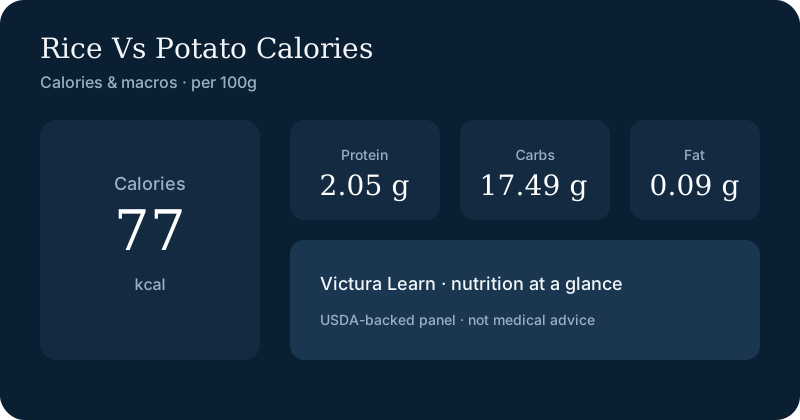
A 100g serving of rice vs potato provides about 77 kcal. Per 100g you get about 17.49g carbs and 2.05g protein. Glycemic index is around 78.
Rice vs Potato is a whole food with approximately 77 calories per 100g, tracked in Victura for macro-aware meal logging.
- Calories (100g serving)
- 77 kcal
- Carbs (100g)
- 17.49g
- Protein (100g)
- 2.05g
- Serving reference
- 100g · 100g serving
- Glycemic index
- 78
The Macronutrient and Caloric Breakdown: Rice vs. Potatoes
Research-backedWhen comparing starches, caloric density is a critical metric. Raw potatoes (flesh and skin) contain 77.0 calories per 100g, with 17.49g of carbohydrates, 2.05g of protein, and a negligible 0.09g of fat. In contrast, cooked white rice typically contains approximately 130 calories per 100g, making potatoes a significantly less calorie-dense option. This difference is primarily due to the higher water content in potatoes. Potatoes also offer 2.1g of dietary fiber and 0.82g of simple sugars per 100g. From a micronutrient perspective, potatoes are highly nutrient-dense, delivering 421mg of Potassium (9% DV) and 19.7mg of Vitamin C (22% DV) per 100g. However, potatoes carry a high Glycemic Index (GI) of 78, which can cause rapid blood glucose spikes if consumed in isolation. For individuals managing diabetes, pairing potatoes with healthy fats or proteins is recommended to mitigate glycemic response.
Real-World Application: Satiety and Performance
Community insightAnonymized meal logs from the Victura community reveal distinct usage patterns for both starches. Users focused on weight loss and volume eating frequently log potatoes due to their high satiety index; the high water and fiber content (2.1g per 100g) helps maintain fullness on fewer calories. Conversely, endurance athletes and individuals in muscle-building phases tend to favor white rice for its rapid digestion and ease of consumption in larger quantities. While potatoes are highly compatible with calorie-restricted plans, they are generally excluded from ketogenic diets due to their high net carbohydrate content (~15.4g per 100g).
References
Frequently asked questions
People also ask
Is a rice vs potato healthy?
Yes — a rice vs potato is a whole food with measurable nutrients. Healthiness depends on overall diet, portions, and your goals. Estimated GI is 78.
Can I eat a rice vs potato every day?
Most people can include a rice vs potato daily as part of a balanced diet, as long as total calories and carbs fit their plan.
Are Rice Vs Potatos good for weight loss?
Rice vs potatos can fit a calorie-controlled diet when portions are measured.
How many calories are in a rice vs potato?
A typical medium serving of rice vs potato has about 77 calories, while 100g contains about 77 calories (USDA reference).
Are Rice Vs Potatos good before a workout?
Rice vs potatos can work before activity when you want easy carbs; pair a rice vs potato with protein if your session is long.
Are Rice Vs Potatos high in sugar?
Rice vs potatos contain about 0.8g sugar per 100g — mostly natural sugars when whole.
Which has more calories, rice or potatoes?
Cooked white rice contains more calories than potatoes per unit of weight. Cooked white rice averages around 130 calories per 100g, whereas raw or boiled potatoes (with skin) contain only 77 calories per 100g.
Is potato better than rice for weight loss?
Yes, potatoes can be highly beneficial for weight loss due to their lower caloric density (77 kcal per 100g) and higher satiety index. They provide more volume and fiber (2.1g per 100g) than cooked white rice, helping you feel full on fewer calories.
Are potatoes healthier than white rice?
Potatoes are more micronutrient-dense than refined white rice, offering 421mg of potassium (9% DV) and 19.7mg of Vitamin C (22% DV) per 100g. However, they have a high glycemic index of 78, meaning they should be paired with protein or fat to prevent rapid blood sugar spikes.
Does cooling potatoes or rice lower their glycemic index?
Yes, cooling cooked potatoes or rice increases resistant starch, which lowers their glycemic index and improves insulin sensitivity.
Which has more carbs, rice or potatoes?
Cooked white rice has more carbohydrates (around 28g per 100g) compared to boiled potatoes (around 17g per 100g).
How we review this guide
- Written by
- Victura Nutrition Team
- Reviewed by
- Victura Editorial Review
- Reference sources
- 4
- Last updated
- Jul 14, 2026
Ready to track your meals with AI?
Victura scans your plate, logs macros automatically, and coaches you toward your goals — halal, keto, diabetic-friendly, and more.