
Watermelon Nutrition Facts: How Many Calories Does Watermelon Have?
Calories, carbs, sugar, and hydration for watermelon — per 100 g (3.5 oz), per 1-cup portion, and per whole melon, with glycemic index, keto, and weight-loss context.
Written by Victura Nutrition TeamReviewed by Victura Editorial ReviewLast updated Oct 14, 2026
30
Calories
0.6g
Protein
7.5g
Carbs
Generally yes
Is it healthy?
per 100g · per panel values
Track this food in VicturaQuick answer
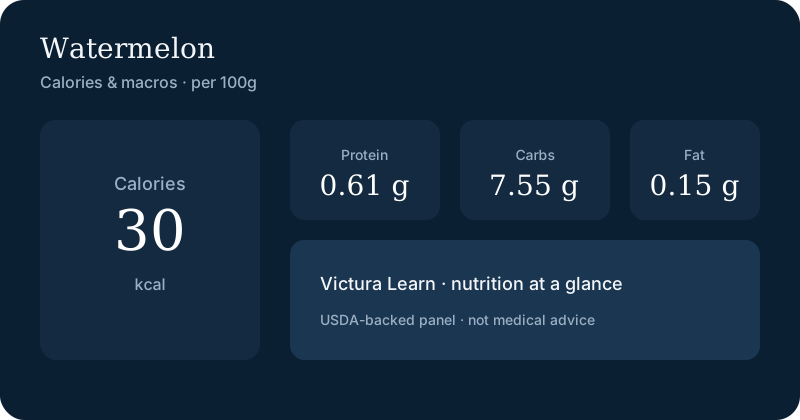
A 100g serving of watermelon provides about 30 kcal. Per 100g you get about 7.55g carbs and 0.61g protein. Glycemic index is around 72.
Watermelon is a whole food with approximately 30 calories per 100g, tracked in Victura for macro-aware meal logging.
- Calories (100g serving)
- 30 kcal
- Carbs (100g)
- 7.55g
- Protein (100g)
- 0.61g
- Serving reference
- 100g · 100g serving
- Glycemic index
- 72
Key takeaways
- Watermelon has 30 calories per 100 g and about 46 calories per 1-cup diced portion.
- A 1-cup serving carries 9.4 g of natural sugar and 0.61 g of fiber.
- Watermelon's glycemic index is 72, but a 1-cup portion has a low glycemic load near 8.
- It is roughly 91% water and supplies vitamin C, vitamin A, potassium, and lycopene.
- Not keto friendly: about 7.15 g net carbs per 100 g, or 10.9 g per cup.

Where the calories come from
Per 100g · protein & carbs 4 kcal/g, fat 9 kcal/g
- Protein0.6 g · 7.2%
- Carbs7.6 g · 88.8%
- Fat0.2 g · 4%
Serving calculator
How much did you eat or drink — Watermelon?
30
Calories
0.6g
Protein
7.5g
Carbs
0.1g
Fat
Nutrition facts
per 100g · Source: USDA FoodData Central (seeded Phase 0)
30 kcal
Calories
Vitamins
- Vitamin C: 8.1mg
- Vitamin A: 28mcg RAE
Minerals
- Potassium: 112mg
Scientific explanation
Research-backedWatermelon provides about 46 calories in a 1-cup diced serving (152 g / 5.4 oz) and 30 calories per 100 g (3.5 oz). The fruit is roughly nine-tenths water by weight, which is why a big-looking bowl still lands under 50 calories. Every number on this page comes from the USDA FoodData Central panel for raw watermelon (FDC ID 167765), with per-cup values scaled from that same panel.
🔥 How Many Calories Does Watermelon Have?
Watermelon has 30 calories per 100 g (3.5 oz) and about 46 calories per 1-cup diced portion (152 g / 5.4 oz). Virtually all of those calories come from carbohydrate (7.55 g per 100 g), while fat (0.15 g) and protein (0.61 g) are close to zero. Because the fruit is mostly water, calories scale almost directly with the size of your slice.
Typical portions:
- 100 g (3.5 oz): 30 calories
- 1 cup diced (152 g / 5.4 oz): about 46 calories
- 1 wedge cut from a 10-lb (4.5 kg) melon — roughly 1/16 of the fruit, about 280 g / 9.9 oz: about 85 calories
- 1 whole small melon (5 lb / 2.3 kg): about 680 calories
Key takeaway: At 30 calories per 100 g, watermelon is one of the lowest-calorie fruits you can eat — a 1-cup portion costs less than a single tablespoon of most nut butters.
📊 Watermelon Nutrition Facts Per 100 g and Per Cup
| Nutrient | Per 100 g (3.5 oz) | Per 1 cup diced (152 g / 5.4 oz) |
|---|---|---|
| Calories | 30 kcal | 46 kcal |
| Protein | 0.61 g | 0.93 g |
| Carbohydrates | 7.55 g | 11.5 g |
| Fat | 0.15 g | 0.23 g |
| Fiber | 0.4 g | 0.61 g |
| Sugar | 6.2 g | 9.4 g |
The per-100 g column is the USDA value as published; the per-cup column multiplies it by 1.52, the gram weight of a standard 1-cup diced portion. Net carbs — total carbohydrate minus fiber — work out to about 7.15 g per 100 g and about 10.9 g per cup. Watermelon is a low-fiber fruit, so most of its carbohydrate arrives as sugar rather than starch or fiber.
🍉 Hydration: A Water-Rich Fruit
Watermelon is roughly 91% water by weight, so a 1-cup diced portion (152 g) delivers about 140 mL (4.7 fl oz) of fluid along with a small amount of electrolytes. That fluid counts toward daily hydration, the same way water from other foods and drinks does.
- Potassium: 112 mg per 100 g (2% DV) — the main electrolyte watermelon contributes
- Fluid: about 140 mL (4.7 fl oz) per 1-cup portion
- Practical note: watermelon is a pleasant way to add fluid on a hot day, but it does not replace drinking water during prolonged heat or exercise.
Because the sugar content is modest per 100 g, hydration is the more meaningful nutrition story here than micronutrient density. If you are tracking fluid rather than calories, log the gram weight and convert using the water content.

🍞 Sugar Content and Glycemic Index
Watermelon carries 6.2 g of sugar per 100 g — about 9.4 g in a 1-cup portion. That sugar is naturally occurring rather than added, and whole fruit is excluded from the "free sugars" that the World Health Organization recommends keeping under 10% of daily calories.
Watermelon's glycemic index is 72, which falls in the high range (70 or above). Glycemic index alone is misleading here, because watermelon contains very little carbohydrate per gram. Glycemic load — glycemic index multiplied by available carbohydrate (total carbohydrate minus fiber) — is about 5.1 per 100 g (72 × 7.15 g ÷ 100) and about 7.8 per 1-cup portion (72 × 10.9 g ÷ 100), both in the low range.
- GI 72: high
- GL per 100 g ≈ 5.1: low
- GL per 1-cup portion ≈ 7.8: low
Measured GI for watermelon varies with variety, ripeness, and study method, so treat 72 as a reference point rather than a fixed property of every melon.
💊 Vitamins, Minerals, and Plant Compounds
Per 100 g, watermelon supplies vitamin C and vitamin A, plus a modest amount of potassium. It is not a multivitamin in fruit form — the amounts are real but small — and its most distinctive contribution is water volume rather than micronutrient density.
- Vitamin C: 8.1 mg per 100 g (9% DV)
- Vitamin A: 28 mcg RAE per 100 g (3% DV)
- Potassium: 112 mg per 100 g (2% DV)
Watermelon is also one of the richest common food sources of lycopene, the carotenoid usually associated with tomatoes, and it contains citrulline, an amino acid studied for vascular and exercise-related effects. These are areas of active research, so the practical takeaway is a fruit that hydrates well and adds a small amount of antioxidant compounds — not a therapeutic dose of anything.
⚖️ Weight Loss, Keto, and Diabetes Considerations
Watermelon sits in an unusual spot: very low in calories per gram, yet relatively high in fast-digesting sugar per serving. Whether it helps or hinders depends almost entirely on portion size and what you eat alongside it.
- Weight loss: flagged as not friendly in Victura's system. At 30 kcal per 100 g it is not calorie-dense, but it is easy to eat 3–4 cups at one sitting, and the sugar arrives without much fiber or fat to slow it down.
- Keto: not keto friendly. At roughly 7.15 g net carbs per 100 g — about 10.9 g per cup — watermelon uses a large share of a standard 20–30 g daily carb budget.
- Diabetes: flagged as not friendly, with a glycemic index of 72 and 6.2 g sugar per 100 g. A 1-cup portion still has a low glycemic load, so pairing it with protein or fat and keeping the portion small is the usual practical strategy.
These flags are general guidance, not medical advice. Anyone managing blood glucose, following a therapeutic diet, or taking medication should confirm portions with a clinician or registered dietitian.
Community insights
Community insightWatermelon shows up in Victura's anonymized meal logs most often as a simple snack rather than an ingredient. The patterns below come from aggregated, de-identified logs and community reporting — they describe habits, not health outcomes.
🍽️ How People Actually Eat Watermelon
The most commonly logged watermelon entry is plain, cubed watermelon in a 1-cup (152 g) portion. After that, members report:
- Blended into water or smoothies, often with lime or mint
- Tossed into fruit salad with berries and other melon
- Paired with feta, mint, and olive oil as a savory summer salad
- Eaten straight off the rind in wedges, where portions are rarely measured
If you want a number rather than an eyeball estimate, the watermelon calorie calculator converts wedges and cups into grams and calories.
🏃 Before and After Workouts
Members frequently log watermelon as a pre-workout snack in summer, because it is easy on the stomach and mostly water. Common pairings reported in logs:
- Watermelon plus a handful of almonds or a string cheese for a slower sugar curve
- Watermelon plus whey or Greek yogurt after training
- Watermelon alone before short, low-intensity sessions
There is promising but not conclusive research on citrulline and exercise performance, so treat watermelon as a pleasant carbohydrate and fluid source rather than a performance supplement.
🍞 Pairings That Slow the Sugar Curve
Because watermelon digests quickly and carries little fiber, the community's most repeated tip is to pair it rather than eat it alone. Fiber, protein, and fat all slow gastric emptying.
- Add protein: Greek yogurt, cottage cheese, or nuts
- Add fat: feta, olive oil, or nut butter
- Add fiber: berries, chia, or a handful of leafy greens in a salad
- Keep the melon portion to 1–2 cups when it is part of a larger meal
Related watery fruits and melons to compare: cantaloupe nutrition, honeydew nutrition, and cucumber nutrition.
🍉 What Trips People Up
Three issues come up again and again in community discussions.
- Serving size drift. A "small" wedge from a large melon can be 300 g or more, which is closer to 90 calories than the 30 people expect from the per-100 g number.
- Counting it as "free" food. Watermelon still contributes sugar and carbohydrate, which matters for keto, low-carb, and glucose management.
- Relying on it for hydration. It helps, but it is not a substitute for water during heat or long training sessions.
If you are tracking, log the gram weight rather than the word "bowl." See the hydration guide for how food water fits into daily fluid targets, and use the Victura app to scan or log portions in seconds.
Pros
Cons
Best time to eat
Good windows
Consider avoiding
Diet compatibility
Weight loss
Friendly
Consult your healthcare provider for personalized guidance.
Keto
Friendly
Consult your healthcare provider for personalized guidance.
Diabetes
Friendly
Consult your healthcare provider for personalized guidance.
Frequently asked questions
People also ask
Is a watermelon healthy?
Yes — a watermelon is a whole food with measurable nutrients. Healthiness depends on overall diet, portions, and your goals. Estimated GI is 72.
Can I eat a watermelon every day?
Most people can include a watermelon daily as part of a balanced diet, as long as total calories and carbs fit their plan.
Are Watermelons good for weight loss?
Watermelons can fit a calorie-controlled diet when portions are measured.
How many calories are in a watermelon?
A typical medium serving of watermelon has about 30 calories, while 100g contains about 30 calories (USDA reference).
Are Watermelons good before a workout?
Watermelons can work before activity when you want easy carbs; pair a watermelon with protein if your session is long.
Are Watermelons high in sugar?
Watermelons contain about 6.2g sugar per 100g — mostly natural sugars when whole.
How many calories does watermelon have?
Watermelon has 30 calories per 100 g (3.5 oz) and about 46 calories in a 1-cup diced portion (152 g / 5.4 oz). A wedge cut from a 10-lb melon (about 280 g / 9.9 oz) is roughly 85 calories, and a whole small 5-lb melon is about 680 calories. Because the fruit is mostly water, calories scale almost directly with portion size.
Is watermelon healthy?
Yes, for most people. Watermelon is roughly 91% water and provides vitamin C (8.1 mg per 100 g, 9% DV), vitamin A (28 mcg RAE, 3% DV), potassium (112 mg, 2% DV), lycopene, and citrulline. It is low in calories and contains no added sugar. The main caveat is portion size: it is easy to eat several cups in one sitting, and it carries 6.2 g of sugar per 100 g.
Can you eat watermelon every day?
For most healthy adults, yes. Whole fruit is not counted as "free sugars" under WHO guidance, which recommends keeping free sugars under 10% of daily calories, so daily watermelon fits inside a balanced diet. Keep portions sensible at 1–2 cups (152–304 g), and if you are watching blood glucose or total carbohydrate, account for the roughly 9.4 g of sugar per cup.
Is watermelon good for weight loss?
It can help, but Victura flags watermelon as not weight-loss friendly for a reason. At 30 calories per 100 g it has one of the lowest calorie densities of any fruit, so it adds volume to a meal for very few calories. The catch is that it is easy to overeat and its sugar digests quickly, so measure portions and pair it with protein, fat, or fiber.
How many calories are in one watermelon?
It depends on size, because calories scale with weight at 30 calories per 100 g (3.5 oz). A small 5-lb (2.3 kg) melon is about 680 calories, a 10-lb (4.5 kg) melon is roughly 1,360 calories, and a large 15-lb (6.8 kg) melon is about 2,040 calories. Slices from the same melon are simply fractions of that total.
Is watermelon high in sugar?
Moderately. Watermelon has 6.2 g of sugar per 100 g — about 9.4 g in a 1-cup portion — all of it naturally occurring, with no added sugar. That is on the lower end among sweet fruits such as bananas and grapes, but higher than berries. Its glycemic index is high at 72, though a typical 1-cup serving has a low glycemic load of about 8.
How we review this guide
- Written by
- Victura Nutrition Team
- Reviewed by
- Victura Editorial Review
- Reference sources
- 9
- Last updated
- Oct 14, 2026
References
- USDA FoodData Central — Watermelon, raw (FDC ID 167765)(usda)
- NIH Office of Dietary Supplements — Vitamin C Fact Sheet for Consumers(nih_ods)
- WHO — Guideline: Sugars intake for adults and children(who)
- Jenkins DJ, et al. Glycemic index of foods: a physiological basis for carbohydrate exchange. Am J Clin Nutr, 1981(pubmed)
- PubMed — Watermelon lycopene and citrulline research (search results)(pubmed)
- Harvard T.H. Chan School of Public Health — Carbohydrates and Blood Sugar(harvard)
- Victura community insights — anonymized watermelon meal logs(victura)
Ready to track your meals with AI?
Victura scans your plate, logs macros automatically, and coaches you toward your goals — halal, keto, diabetic-friendly, and more.