
Cherries Nutrition Facts
Calories, sugar, fiber, and evidence-based health notes for sweet raw cherries, with per-100 g and per-cup values.
Written by Victura Nutrition TeamReviewed by Victura Editorial ReviewLast updated Oct 19, 2026
63
Calories
1.1g
Protein
16.0g
Carbs
Generally yes
Is it healthy?
per 100g · per panel values
Track this food in VicturaQuick answer
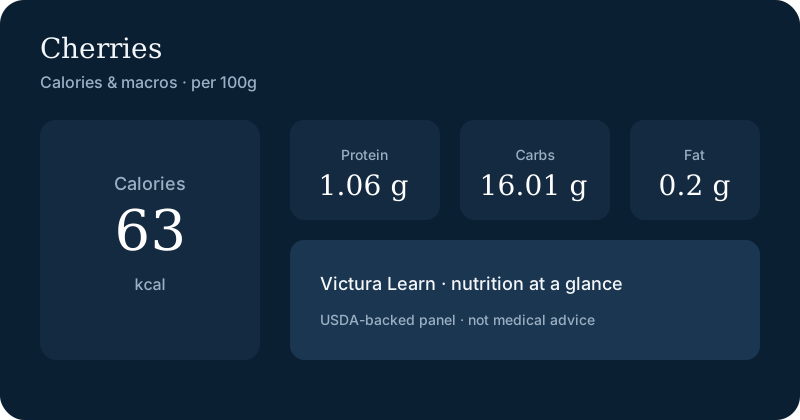
A 100g serving of cherries provides about 63 kcal. Per 100g you get about 16.01g carbs and 1.06g protein.
Cherries is a whole food with approximately 63 calories per 100g, tracked in Victura for macro-aware meal logging.
- Calories (100g serving)
- 63 kcal
- Carbs (100g)
- 16.01g
- Protein (100g)
- 1.06g
- Serving reference
- 100g · 100g serving
Key takeaways
- A 1-cup pitted serving (154 g / 5.4 oz) has about 97 calories and 19.7 g sugar.
- Per 100 g (3.5 oz), cherries provide 63 calories, 2.1 g fiber, and 12.82 g sugar.
- Cherries fit weight-loss and diabetes-friendly plans in measured portions, not unlimited amounts.
- Tart cherry juice has limited evidence for sleep; it is not a treatment for insomnia.
- Fresh, frozen, and dried cherries differ in portion size; check labels for added sugar.

Where the calories come from
Per 100g · protein & carbs 4 kcal/g, fat 9 kcal/g
- Protein1.1 g · 6.1%
- Carbs16 g · 91.4%
- Fat0.2 g · 2.6%
Serving calculator
How much did you eat or drink — Cherries?
63
Calories
1.1g
Protein
16.0g
Carbs
0.2g
Fat
Nutrition facts
per 100g · Source: USDA FoodData Central
63 kcal
Calories
Scientific explanation
Research-backedCherries provide about 97 calories in a typical 1-cup pitted serving (154 g / 5.4 oz), or 63 calories per 100 g (3.5 oz). That same cup supplies about 24.66 g carbs, 3.23 g fiber, and 19.74 g sugar. The USDA panel for this page is for sweet, raw cherries and is the source for all per-100 g values.
🔥 Calories and serving size
The table uses the USDA FoodData Central panel for sweet raw cherries. Cup values are scaled from the per-100 g panel using 154 g (5.4 oz) of pitted cherries, a common household serving.
| Nutrient | Per 100 g (3.5 oz) | Per 1 cup pitted (154 g / 5.4 oz), estimated |
|---|---|---|
| Calories | 63 kcal | 97 kcal |
| Protein | 1.06 g | 1.63 g |
| Carbs | 16.01 g | 24.66 g |
| Fat | 0.2 g | 0.31 g |
| Fiber | 2.1 g | 3.23 g |
| Sugar | 12.82 g | 19.74 g |
Cherry size varies, so use grams when precision matters. One average sweet cherry is about 5 g (0.18 oz), and 10 cherries are about 50 g (1.8 oz).
🍞 Fiber, sugar, and carbs
Cherries are mostly carbohydrate and water, with very little protein or fat. The 2.1 g fiber per 100 g (3.5 oz) is modest but useful, while 12.82 g sugar per 100 g explains why cherries taste sweet. Net carbs are about 13.9 g per 100 g when fiber is subtracted, which is too high for strict keto.
Practical portions:
- 1 cup pitted (154 g / 5.4 oz): about 24.66 g carbs, 3.23 g fiber, and 19.74 g sugar.
- 1/2 cup pitted (77 g / 2.7 oz): about 12.33 g carbs, 1.62 g fiber, and 9.87 g sugar.
- 10 cherries (about 50 g / 1.8 oz): about 8.0 g carbs and 6.41 g sugar.
Watch out: Cherries are moderate in sugar: a 1-cup pitted serving (154 g / 5.4 oz) has about 19.7 g sugar, so portion size matters for blood-sugar and calorie goals.

🍒 Antioxidants and inflammation
Sweet cherries get their red-purple color from anthocyanins, a group of polyphenols. These compounds are the main reason cherries are studied for antioxidant and anti-inflammatory effects. The USDA panel in this article does not quantify anthocyanins or other phytonutrients.
Human research often uses tart cherry juice, concentrates, or extracts rather than fresh sweet cherries. Some studies report changes in markers of inflammation or exercise recovery, but results are not consistent. Cherries are not a treatment for arthritis, gout, or other inflammatory conditions.
🍞 Blood sugar, gout, and daily eating
The panel does not provide a glycemic index for cherries, so this page does not assign one. Cherries may fit diabetes-friendly eating patterns in moderation because the fruit contains fiber, but the 12.82 g sugar per 100 g (3.5 oz) still counts. Pair cherries with protein or fat and keep portions measured.
Cherries have been studied for gout and uric acid, but the evidence is not strong enough to recommend them as a substitute for medication. The provided USDA panel also does not list potassium or vitamin C values, so we do not invent those numbers. Use the full USDA record or a lab-tested label if you need mineral or vitamin totals.
🍒 Sleep and cherry juice
Tart cherry juice has been studied for sleep because it contains small amounts of melatonin and tryptophan. A small trial found that tart cherry juice increased sleep time and sleep efficiency compared with placebo. That study used juice, not a 1-cup serving (154 g / 5.4 oz) of fresh sweet cherries.
Juice can be concentrated in sugar and easy to drink quickly. If you try cherry juice, keep the portion small, such as 1/2 cup (about 120 g / 4 fl oz), and check for added sugar. Sleep problems deserve clinical care, not just a fruit juice experiment.
Community insights
Community insight🍒 Buying and storing cherries
Choose firm, glossy cherries with fresh green stems and no soft spots. Keep them unwashed in the refrigerator and rinse just before eating. Cherries can be frozen pitted on a tray, then stored in a bag for smoothies or oatmeal.
- Fresh: refrigerate and use within about a week for best quality.
- Frozen: freeze pitted cherries in a single layer, then transfer to a container.
- Dried: choose products without added sugar when possible and check the label.
🍽️ Practical ways to eat cherries
Cherries work in sweet and savory dishes, but portions are easier to control when you pit and weigh them first. These are practical Victura-style serving ideas:
- Yogurt bowl: 1/2 cup pitted cherries (77 g / 2.7 oz) with Greek yogurt and nuts.
- Oatmeal: 1/2 cup pitted cherries (77 g / 2.7 oz) stirred in after cooking.
- Salad: 1/4 cup pitted cherries (39 g / 1.4 oz) with greens, chicken, and vinegar.
- Frozen snack: 1 cup frozen cherries (154 g / 5.4 oz) blended into a smoothie or eaten slowly.
- Sauce: simmer 1 cup pitted cherries (154 g / 5.4 oz) with lemon and a pinch of salt for pork or poultry.
🍒 Logging cherries in Victura
Cherry pits make portion tracking tricky, so weigh the edible fruit after pitting when you can. If you use cups, remember that 1 cup pitted sweet cherries is about 154 g (5.4 oz), not 1 cup of whole cherries with pits. Logging the edible weight keeps your daily totals closer to the USDA panel.
The Victura app can store repeat meals and compare portions. For a broader plan, pair this page with the weight-loss hub and the calorie calculator. These links support the fruit cluster without replacing individual medical advice.
🍒 Frozen, dried, and juice
Frozen cherries are usually picked and frozen near harvest, so they can be a practical year-round option. Dried cherries are concentrated: a 1/4-cup portion (about 40 g / 1.4 oz) can deliver more sugar than the same volume of fresh fruit. Check labels for added sugar, especially in dried and juiced products.
Cherry juice is not the same as whole fruit because it removes most fiber and can concentrate sugar. A small 1/2-cup glass (about 120 g / 4 fl oz) is a more measured portion than a large bottle. If you enjoy juice, treat it as a supplement to whole fruit, not a replacement.
🍒 Cherries vs. other fruit
Sweet cherries are similar to blueberries and strawberries in that they are whole fruits with fiber and polyphenols. Cherries are sweeter and higher in sugar than many berries, so portion size is the main difference for blood-sugar and calorie goals. Use the same practical rule: measure the edible portion, then compare within your daily plan.
Pros
Cons
Best time to eat
Good windows
Consider avoiding
Diet compatibility
Weight loss
Friendly
Consult your healthcare provider for personalized guidance.
Keto
Friendly
Consult your healthcare provider for personalized guidance.
Diabetes
Friendly
Consult your healthcare provider for personalized guidance.
Frequently asked questions
People also ask
Is a cherries healthy?
Yes — a cherries is a whole food with measurable nutrients. Healthiness depends on overall diet, portions, and your goals.
Can I eat a cherries every day?
Most people can include a cherries daily as part of a balanced diet, as long as total calories and carbs fit their plan.
Are Cherrieses good for weight loss?
Cherrieses can fit a calorie-controlled diet when portions are measured.
How many calories are in a cherries?
A typical medium serving of cherries has about 63 calories, while 100g contains about 63 calories (USDA reference).
Are Cherrieses good before a workout?
Cherrieses can work before activity when you want easy carbs; pair a cherries with protein if your session is long.
Are Cherrieses high in sugar?
Cherrieses contain about 12.8g sugar per 100g — mostly natural sugars when whole.
Are cherries healthy?
Cherries are a whole fruit that provide carbohydrate, fiber, and polyphenols. Per 100 g (3.5 oz), USDA lists 63 calories, 2.1 g fiber, and 12.82 g sugar. They can fit most eating patterns in measured portions; people tracking blood sugar or calories should account for the sugar.
Is it okay to eat cherries every day?
Yes, most people can eat cherries daily in moderate portions, such as 1/2 to 1 cup pitted (77–154 g / 2.7–5.4 oz). Rotate with other fruits to broaden nutrient intake. If you have diabetes, gout, or a digestive condition, individual tolerance and medical advice matter.
Are cherries good for weight loss?
Cherries can fit weight-loss plans because they are low in calories per 100 g (63 kcal) and contain fiber. A 1-cup pitted serving (154 g / 5.4 oz) is about 97 calories, but it also has about 19.7 g sugar. Measure portions and pair cherries with protein or healthy fat to stay satisfied.
How many calories are in one cherry?
One average sweet cherry weighs about 5 g (0.18 oz), so it provides roughly 3 calories based on the USDA panel of 63 kcal per 100 g (3.5 oz). Ten cherries (about 50 g / 1.8 oz) provide roughly 32 calories. Use grams for accurate logging because cherry size varies.
Can you eat cherries before a workout?
Cherries can be a light pre-workout snack because they provide carbs and fluid. A small portion, such as 1/2 cup pitted (77 g / 2.7 oz), has about 12 g carbs and may help before easy training. For intense or long sessions, pair them with protein or a larger carb source and avoid large amounts of juice if it causes stomach upset.
Are cherries high in sugar?
Yes, cherries are moderate-to-high in sugar for a fruit. The USDA panel lists 12.82 g sugar per 100 g (3.5 oz), and a 1-cup pitted serving (154 g / 5.4 oz) has about 19.7 g sugar. The fiber (2.1 g per 100 g) helps slightly, but portion size still matters.
How we review this guide
- Written by
- Victura Nutrition Team
- Reviewed by
- Victura Editorial Review
- Reference sources
- 5
- Last updated
- Oct 19, 2026
References
- USDA FoodData Central: Cherries, sweet, raw (FDC ID 171719)(usda)
- Howatson G, et al. Effect of tart cherry juice (Prunus cerasus) on melatonin levels and enhanced sleep quality. European Journal of Nutrition. 2012.(pubmed)
- Zhang Y, et al. Cherry consumption and decreased risk of recurrent gout attacks. Arthritis & Rheumatism. 2012.(pubmed)
Ready to track your meals with AI?
Victura scans your plate, logs macros automatically, and coaches you toward your goals — halal, keto, diabetic-friendly, and more.