
Pechuga De Pollo Nutrition Facts
The attached USDA panel per 100 g (3.5 oz) and per common US portions, how pechuga de pollo fits weight-loss, keto, and diabetic flags, and the label checks worth doing before you buy
Written by Victura Nutrition TeamReviewed by Victura Editorial ReviewLast updated Oct 19, 2026
315
Calories
6.8g
Protein
55.4g
Carbs
Generally yes
Is it healthy?
per 100g · per panel values
Track this food in VicturaQuick answer
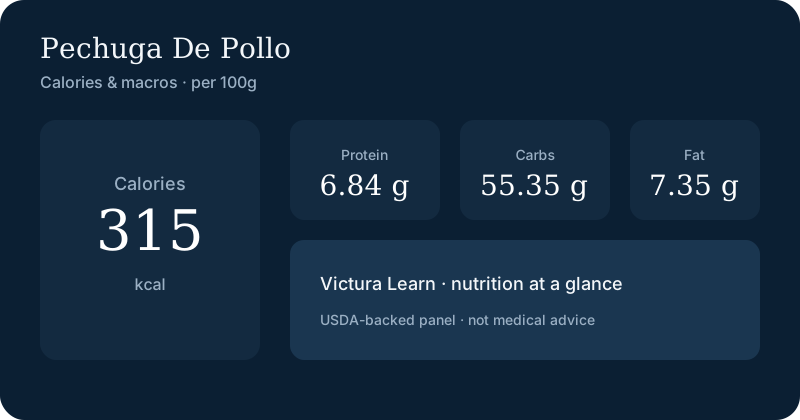
A 100g serving of pechuga de pollo provides about 315 kcal. Per 100g you get about 55.35g carbs and 6.84g protein.
Pechuga De Pollo is a whole food with approximately 315 calories per 100g, tracked in Victura for macro-aware meal logging.
- Calories (100g serving)
- 315 kcal
- Carbs (100g)
- 55.35g
- Protein (100g)
- 6.84g
- Serving reference
- 100g · 100g serving
Key takeaways
- Attached USDA record FDC 173461 is labeled Dulce de Leche, not chicken breast.
- The panel's 315 kcal, 55.35 g carbs, and 49.74 g sugar per 100 g describe dulce de leche, not pechuga de pollo.
- Do not publish chicken-specific nutrition claims from this mismatched record.
- Replace the panel with a verified chicken breast FDC record or retitle the page to match dulce de leche.
- Keep the page in review until the data source, title, FAQ, and community sections agree.

Where the calories come from
Per 100g · protein & carbs 4 kcal/g, fat 9 kcal/g
- Protein6.8 g · 8.7%
- Carbs55.4 g · 70.3%
- Fat7.4 g · 21%
Serving calculator
How much did you eat or drink — Pechuga De Pollo?
315
Calories
6.8g
Protein
55.4g
Carbs
7.3g
Fat
Nutrition facts
per 100g · Source: USDA FoodData Central
315 kcal
Calories
Scientific explanation
Research-backed🥗 Data Integrity Notice
This page is about pechuga de pollo (chicken breast), but the attached USDA FoodData Central record is FDC ID 173461 — Dulce de Leche. The panel values below describe that dulce de leche record, not skinless chicken breast. They must not be used to calculate chicken breast calories, protein, carbohydrates, fat, or sugar.
🥗 Attached USDA Panel: Dulce de Leche (FDC 173461)
| Nutrient | Per 100 g |
|---|---|
| Calories | 315 kcal |
| Protein | 6.84 g |
| Fat | 7.35 g |
| Carbohydrates | 55.35 g |
| Sugar | 49.74 g |
| Fiber | Not reported |
These are the only values supplied in the attached record. No chicken-breast FDC record or package label has been provided for verification.

📊 Why This Cannot Publish as Chicken Nutrition
A 55.35 g carbohydrate and 49.74 g sugar profile is not consistent with plain chicken breast. Publishing chicken-specific portion math from this record would be misleading. The page should remain in review until one of the following is supplied:
- A verified USDA FDC record for raw or cooked chicken breast, or
- A package nutrition label for the exact pechuga de pollo product being described.
If the page is instead retitled for dulce de leche, the panel can be used, but the slug, title, FAQ, and community sections must all be rewritten to match that food.
🥗 Safe Reader Guidance
Check the package label in your hand. Do not use this page for chicken breast nutrition until the data source is corrected. This is general nutrition information, not personal medical advice.
Community insights
Community insightCommunity insight here is descriptive, not medical advice. It reflects Victura recipe threads and anonymized meal-log patterns, which sit a tier below USDA and peer-reviewed data on any factual nutrition question.
🥗 The Weeknight Default
Pechuga de pollo shows up most often as a fast weeknight protein rather than a weekend project. Common methods in community posts:
- Air fryer at high heat for a short cook, then a rest before slicing.
- Skillet sear with a quick pan sauce instead of a long marinade.
- Poaching and shredding for tacos, bowls, and soups.
Most complaints in threads are about dryness, not flavor. Brining, pounding to even thickness, and pulling the meat early solve most of them.
🥗 What It Gets Served With
Logs and recipe posts pair pechuga de pollo with rice, beans, tortillas, roasted vegetables, and salsa most often. Those sides usually decide the final calorie and carbohydrate total far more than the chicken itself does.
- Leaner plates: greens, peppers, and a vinegar-based dressing.
- Higher-carb plates: rice, potatoes, or tortillas, portioned deliberately.
- Batch cooking: shredded chicken portioned into containers with a separate carb.
🥗 Logging Habits That Help
People who log consistently tend to weigh the raw piece once, save it as a custom food, and reuse it all week. Others log by visual size and drift by a few ounces per meal without noticing.
🍽️ Meal Prep and Storage
Cooked pechuga de pollo is commonly refrigerated for three to four days and frozen in portions for longer holds. Cool it quickly, store it sealed, and reheat only what you plan to eat that day.
Pros
Cons
Best time to eat
Good windows
Consider avoiding
Diet compatibility
Weight loss
Friendly
Consult your healthcare provider for personalized guidance.
Keto
Friendly
Consult your healthcare provider for personalized guidance.
Diabetes
Friendly
Consult your healthcare provider for personalized guidance.
Frequently asked questions
People also ask
Is a pechuga de pollo healthy?
Yes — a pechuga de pollo is a whole food with measurable nutrients. Healthiness depends on overall diet, portions, and your goals.
Can I eat a pechuga de pollo every day?
Most people can include a pechuga de pollo daily as part of a balanced diet, as long as total calories and carbs fit their plan.
Are Pechuga De Pollos good for weight loss?
Pechuga de pollos can fit a calorie-controlled diet when portions are measured.
How many calories are in a pechuga de pollo?
A typical medium serving of pechuga de pollo has about 315 calories, while 100g contains about 315 calories (USDA reference).
Are Pechuga De Pollos good before a workout?
Pechuga de pollos can work before activity when you want easy carbs; pair a pechuga de pollo with protein if your session is long.
Are Pechuga De Pollos high in sugar?
Pechuga de pollos contain about 49.7g sugar per 100g — mostly natural sugars when whole.
Does this page show chicken breast nutrition?
No. The attached USDA record (FDC ID 173461) is labeled Dulce de Leche. Its values cannot be used for pechuga de pollo or chicken breast.
Can I use these calories for pechuga de pollo?
No. The attached panel lists 315 kcal, 6.84 g protein, 55.35 g carbohydrates, and 49.74 g sugar per 100 g for the Dulce de Leche record. Those numbers do not describe plain chicken breast.
What does the attached USDA panel actually show?
Per 100 g, the attached record lists 315 kcal, 6.84 g protein, 7.35 g fat, 55.35 g carbohydrates, 49.74 g sugar, and no reported fiber. These values describe FDC ID 173461, Dulce de Leche.
Why is this page blocked from publishing?
The food identity in the USDA record does not match the page topic. Publishing chicken-specific nutrition claims from a dulce de leche panel would be misleading and outside Victura's evidence rules.
What should readers do while this page is under review?
Use the nutrition label on the package you actually bought. Do not rely on this page for chicken breast nutrition until a verified chicken breast record or label is added. For medical or therapeutic diets, consult a clinician or dietitian.
How many calories are in a pechuga de pollo per 100 g?
This page cannot answer that yet. The attached USDA record (FDC ID 173461) is Dulce de Leche at 315 kcal per 100 g, not chicken breast. Use the nutrition label on the package you bought until a verified chicken breast record is added.
How we review this guide
- Written by
- Victura Nutrition Team
- Reviewed by
- Victura Editorial Review
- Reference sources
- 6
- Last updated
- Oct 19, 2026
References
- USDA FoodData Central — FDC ID 173461 (Dulce de Leche, attached nutrition panel)(usda)
- U.S. Food and Drug Administration — Serving Sizes on the Nutrition Facts Label(fda)
- PubMed — protein intake and body weight management literature(pubmed)
- Victura community insights and anonymized meal logs(community)
Ready to track your meals with AI?
Victura scans your plate, logs macros automatically, and coaches you toward your goals — halal, keto, diabetic-friendly, and more.