
Kombucha Tea Nutrition Facts
Calories, carbs, sugar, and live cultures per 100 g and per 8 fl oz cup — plus how kombucha fits weight loss, keto, diabetes, and daily drinking.
Written by Victura Nutrition TeamReviewed by Victura Editorial ReviewLast updated Nov 12, 2026
13
Calories
0.1g
Protein
15.8g
Carbs
Generally yes
Is it healthy?
per 100g · per panel values
Track this food in VicturaQuick answer
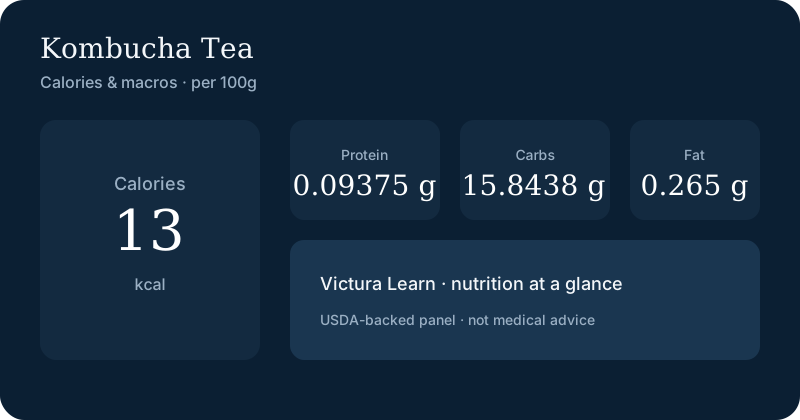
A 100g serving of kombucha tea provides about 13 kcal. Per 100g you get about 15.8438g carbs and 0.09375g protein.
Kombucha Tea is a whole food with approximately 13 calories per 100g, tracked in Victura for macro-aware meal logging.
- Calories (100g serving)
- 13 kcal
- Carbs (100g)
- 15.84375g
- Protein (100g)
- 0.09375g
- Serving reference
- 100g · 100g serving
Key takeaways
- Kombucha Tea has about 13 calories and 2 g sugar per 100 g.
- An 8 fl oz cup delivers roughly 31 calories and 4.8 g sugar.
- It supplies no meaningful protein, fat, fiber, or vitamins.
- Flavored 16 fl oz bottles can match soda for sugar.
- Live cultures vary by brand; pasteurized bottles have none.

Where the calories come from
Per 100g · protein & carbs 4 kcal/g, fat 9 kcal/g
- Protein0.1 g · 0.6%
- Carbs15.8 g · 95.8%
- Fat0.3 g · 3.6%
Serving calculator
How much did you eat or drink — Kombucha Tea?
13
Calories
0.1g
Protein
15.8g
Carbs
0.3g
Fat
Nutrition facts
per 100g · Source: USDA FoodData Central
13 kcal
Calories
Minerals
- Sodium: 5mg
Scientific explanation
Research-backedKombucha Tea provides about 13 calories, 15.8 g of carbohydrates, and 2 g of sugar per 100 g (3.5 oz), with virtually no protein, fat, or fiber. It is fermented sweet tea — tea leaves, sugar, water, and a live culture — so its numbers depend on fermentation time and on whatever juice or sweetener is added before bottling. That is why two bottles of the same size can differ by 10 g of sugar or more.
🍵 What Kombucha Tea Is
- Base: brewed black or green tea sweetened with sugar, which feeds the culture.
- Culture: a SCOBY — a symbiotic culture of bacteria and yeast — ferments the tea for roughly 7–14 days.
- Output: acetic, gluconic, and lactic acids, carbon dioxide, trace ethanol, and live microorganisms.
- Finishing: most commercial bottles get fruit juice, puree, or extra sugar for flavor after primary fermentation.
- Standard pours in the US and Canada: 8 fl oz (240 mL, 1 cup), 12 fl oz (355 mL), and 16 fl oz (473 mL).
The table below is the reference panel for this entry, sourced from USDA FoodData Central (FDC 2003593). Because kombucha is a live product, treat any single table as a baseline and read your bottle's label.
🔥 Calories and Carbs per Serving
| Nutrient | Per 100 g (3.5 oz) | Per 1 cup, 240 g (8 fl oz) |
|---|---|---|
| Calories | 13 kcal | 31 kcal |
| Protein | 0.09 g | 0.23 g |
| Carbohydrates | 15.84 g | 38.0 g |
| Fat | 0.27 g | 0.64 g |
| Fiber | 0.0 g | 0.0 g |
| Sugar | 2.0 g | 4.8 g |
| Sodium | 5 mg | 12 mg |
One cup of kombucha lands near 31 calories, which makes it one of the lighter drinks in the fridge — well below soda, sweetened iced tea, or juice. Double the cup column for a 16 fl oz (473 mL) bottle and you are still around 62 calories with roughly 9.6 g of sugar. The catch is carbohydrate volume: 38 g per cup is substantial for anyone counting carbs, so check whether your brand ferments longer or dilutes with water before drinking.
🍞 Sugar, Fiber, and the Fermentation Question
Fermentation consumes sugar, which is why good kombucha tastes tart rather than syrupy. In practice, bottled brands range from about 2 g to 20 g of sugar per serving, depending on how dry the brew is and how much juice is added back.
- Dry or original brews usually sit at the low end — often 2–6 g of sugar per 8 fl oz cup.
- Flavored bottles can approach soda levels, especially 16 fl oz sizes drunk as a single portion.
- Fiber is 0.0 g, so kombucha contributes nothing toward the 25–30 g of daily fiber most adults aim for.
Watch out: A 16 fl oz flavored bottle can carry as much sugar as a can of soda. If sugar is your reason for switching, buy unflavored or low-sugar labels and check grams per bottle, not grams per 100 mL.

💪 Protein, Fat, and Micronutrients
Protein at 0.09 g and fat at 0.27 g per 100 g are rounding-error amounts — kombucha is not a protein or fat source and should never be counted as one. The panel lists no vitamins above trace levels and only 5 mg of sodium per 100 g (about 12 mg per cup), so it is not a meaningful source of electrolytes either.
Some lab analyses of fermented tea report small amounts of B vitamins and tea polyphenols carried over from the green or black tea base. Those amounts are not standardized across brews and are not captured as meaningful values here, so treat them as a bonus rather than a reason to drink it.
🍵 Probiotics, Polyphenols, and the Evidence Base
Kombucha carries live yeast and bacteria, which is the main reason people drink it. Human evidence is still thin: most studies are small, short, or in animals, and reviews consistently call for larger controlled trials before any disease claims are made.
- Gut health: the culture may support a more diverse microbiome, but strain counts and CFU levels vary enormously between products — and many bottled brands are pasteurized, which removes live cultures.
- Blood sugar: a few small trials in adults with type 2 diabetes reported modest fasting glucose improvements; these are preliminary, not prescriptive.
- Antioxidants: tea polyphenols survive fermentation in reduced amounts, so the effect is smaller than drinking the brewed tea itself.
Anyone who is pregnant, immunocompromised, or managing a chronic condition should talk with a clinician before drinking unpasteurized kombucha.
⚖️ Where It Fits: Weight Loss, Keto, and Diabetes
At roughly 13 kcal per 100 g, kombucha is not calorie-dense — a cup is about 31 calories. It supports weight loss only as a replacement for sugary drinks, not as an addition, and the 38 g of carbohydrate per cup still counts against a daily budget. For keto, 15.8 g of net carbs per 100 g is too high for most people's macros, and even a small glass can consume a quarter of a 50 g carb allowance.
The panel lists no glycemic index, and published GI values for kombucha are not established. With 2 g of sugar per 100 g, a dry brew is unlikely to spike blood sugar sharply, but sweetened bottles behave differently — test with a meter if you monitor glucose. Compare kombucha with green tea or kefir if you want lower-sugar fermented options, and check the nutrition calculator to see how a bottle shifts your daily totals.
Community insights
Community insightVictura members log kombucha most often as a mid-afternoon replacement for soda or a second coffee, and the logged portions are smaller than the bottles sold. An 8 fl oz cup three to five times a week is the common pattern; 16 fl oz bottles get logged as one drink and are where sugar totals jump.
🍵 Logging Patterns We See
- Afternoon slump (2–4 p.m.): the most common time, usually 8 fl oz over ice.
- Pre-workout: members who drink it 30–45 minutes before training tend to choose unflavored or ginger labels.
- Meal pairing: logged with lunch more than dinner, often instead of a soft drink.
- Weekend brewing: home brewers log smaller, more frequent pours and note that batch strength varies.
- Mixer use: a splash in a mocktail or spritz, which keeps the sugar per drink low.
🍵 What People Check Before Buying
- Sugar grams per bottle, not per 100 mL — the label math trips people up most often.
- "Raw" or "unpasteurized" on the label, since pasteurized bottles have no live cultures.
- Alcohol content, especially for home brews and brands that skip pasteurization.
- Caffeine, which matters for anyone drinking a bottle after 6 p.m.
- Cost per ounce, which is high compared with tea, so many members alternate with kimchi and kefir for fermented foods.
🍵 Habits That Stick
- Buy one 16 fl oz bottle and split it into two 8 fl oz pours over two days.
- Start with 4–6 fl oz to see how your stomach reacts, then build slowly.
- Keep a dry, unflavored bottle for weekdays and save flavored ones for occasional treats.
- Store bottles cold and drink within a few days of opening to limit further fermentation.
- Log it like any other drink — a bottle quietly adds carbs that are easy to miss when you are tracking for weight loss.
Members consistently say the biggest change is substitution, not addition: kombucha works when it replaces something sweeter, not when it stacks on top of it.
Pros
Cons
Best time to eat
Good windows
Consider avoiding
Diet compatibility
Weight loss
Friendly
Consult your healthcare provider for personalized guidance.
Keto
Friendly
Consult your healthcare provider for personalized guidance.
Diabetes
Friendly
Consult your healthcare provider for personalized guidance.
Frequently asked questions
People also ask
Is a kombucha tea healthy?
Yes — a kombucha tea is a whole food with measurable nutrients. Healthiness depends on overall diet, portions, and your goals.
Can I eat a kombucha tea every day?
Most people can include a kombucha tea daily as part of a balanced diet, as long as total calories and carbs fit their plan.
Are Kombucha Teas good for weight loss?
Kombucha teas can fit a calorie-controlled diet when portions are measured.
How many calories are in a kombucha tea?
A typical medium serving of kombucha tea has about 13 calories, while 100g contains about 13 calories (USDA reference).
Are Kombucha Teas good before a workout?
Kombucha teas can work before activity when you want easy carbs; pair a kombucha tea with protein if your session is long.
Are Kombucha Teas high in sugar?
Kombucha teas contain about 2.0g sugar per 100g — mostly natural sugars when whole.
Is kombucha tea healthy?
Kombucha tea is a low-calorie fermented drink that can replace soda or sweetened iced tea, and it supplies live cultures plus tea polyphenols. The human evidence for specific health benefits is still limited and mostly from small or short trials. It is a reasonable everyday drink for most healthy adults, not a treatment.
Is it safe to drink kombucha tea every day?
Most healthy adults can drink 4–8 fl oz daily without issues. Start smaller if you are new to fermented foods, since the acids and live cultures can cause gas or upset stomach at first. People who are pregnant, immunocompromised, or managing a chronic condition should check with a clinician before drinking unpasteurized kombucha.
Can kombucha tea help with weight loss?
Only indirectly. At about 13 calories per 100 g, a cup is roughly 31 calories, so it helps when it replaces soda or juice. It does not burn fat, and a 16 fl oz flavored bottle can add 60 or more calories and about 10 g of sugar. Track it like any other drink.
How many calories are in one kombucha?
It depends on the bottle size. Using the reference panel, an 8 fl oz (240 g) cup has about 31 calories, a 12 fl oz (355 mL) bottle about 46 calories, and a 16 fl oz (473 mL) bottle about 62 calories. Flavored or juice-added brands can be noticeably higher.
Is it good to drink kombucha tea before a workout?
A small 4–8 fl oz pour about 30–45 minutes before training is fine for most people and gives a light carbohydrate top-up. It is not a sports drink — sodium is only about 12 mg per cup — so it will not replace electrolytes after heavy sweating. Choose an unflavored or low-sugar bottle to avoid a sugar load right before exercise.
Is kombucha tea high in sugar?
It can be. The reference panel shows 2 g of sugar per 100 g, or about 4.8 g per 8 fl oz cup, which is low. But flavored commercial bottles commonly land between 8 and 20 g per bottle, so check the grams per bottle on the label rather than assuming all kombucha is dry.
How we review this guide
- Written by
- Victura Nutrition Team
- Reviewed by
- Victura Editorial Review
- Reference sources
- 8
- Last updated
- Nov 12, 2026
References
- USDA FoodData Central — FoodData Central database (FDC ID 2003593)(usda)
- World Health Organization — Healthy diet fact sheet(who)
- U.S. Food and Drug Administration — Food safety and labeling(fda)
- PubMed — Randomized controlled trials on kombucha(pubmed)
- PubMed — Systematic reviews of kombucha health benefits(pubmed)
- Victura anonymized meal logs — kombucha portion patterns(victura)
Ready to track your meals with AI?
Victura scans your plate, logs macros automatically, and coaches you toward your goals — halal, keto, diabetic-friendly, and more.