
Kombucha Drink Nutrition Facts
Calories, sugar, carbs, and evidence-based answers for kombucha drinkers.
Written by Victura Nutrition TeamReviewed by Victura Editorial ReviewLast updated Nov 13, 2026
13
Calories
0.1g
Protein
15.8g
Carbs
Generally yes
Is it healthy?
per 100g · per panel values
Track this food in VicturaQuick answer
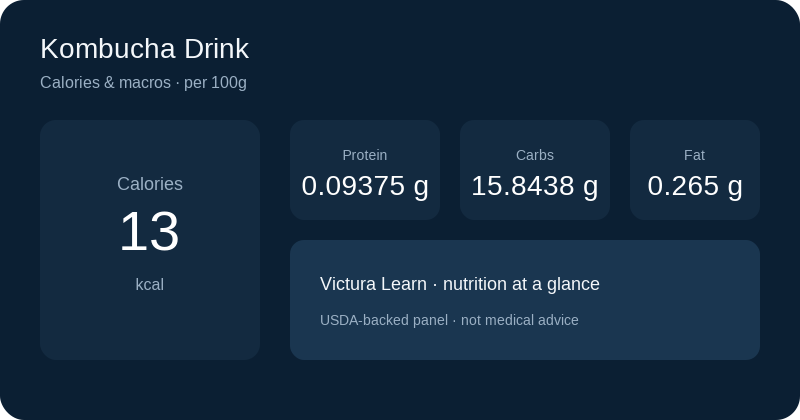
A 100g serving of kombucha drink provides about 13 kcal. Per 100g you get about 15.8438g carbs and 0.09375g protein.
Kombucha Drink is a whole food with approximately 13 calories per 100g, tracked in Victura for macro-aware meal logging.
- Calories (100g serving)
- 13 kcal
- Carbs (100g)
- 15.84375g
- Protein (100g)
- 0.09375g
- Serving reference
- 100g · 100g serving
Key takeaways
- A typical 8 fl oz kombucha drink has about 31 calories on the supplied panel.
- The panel lists 2.0 g sugar and 15.84 g carbs per 100 g, so brand labels matter.
- Kombucha may contain trace alcohol, caffeine, and live cultures; amounts vary.
- Human evidence for health benefits is promising but limited; it is not a medicine.
- Check bottle size and added sugar if you drink kombucha daily or track carbs.

Where the calories come from
Per 100g · protein & carbs 4 kcal/g, fat 9 kcal/g
- Protein0.1 g · 0.6%
- Carbs15.8 g · 95.8%
- Fat0.3 g · 3.6%
Serving calculator
How much did you eat or drink — Kombucha Drink?
13
Calories
0.1g
Protein
15.8g
Carbs
0.3g
Fat
Nutrition facts
per 100g · Source: USDA FoodData Central
13 kcal
Calories
Minerals
- Sodium: 5mg
Scientific explanation
Research-backedKombucha Drink provides about 31 calories in a typical 8 fl oz (240 ml) bottle, or 13 kcal per 100 g (3.5 oz). The supplied USDA panel lists 15.84 g carbs, 2.0 g sugar, 0.09 g protein, and 0.27 g fat per 100 g. Because kombucha is fermented tea, values can change with brand, flavor, sweetness, and bottle size.
🔥 Calories and Serving Size
Most people want to know the calories in one bottle before they buy. The table below uses the supplied panel and calculates an 8 fl oz (240 ml / 240 g) serving so you can compare it with a label. If your bottle is 16 fl oz (480 ml), double the 8 fl oz values.
| Nutrient | Per 100 g (3.5 oz) | Per 8 fl oz (240 ml / 240 g) |
|---|---|---|
| Calories | 13.0 kcal | 31.2 kcal |
| Protein | 0.09375 g | 0.225 g |
| Carbs | 15.84375 g | 38.025 g |
| Fat | 0.265 g | 0.636 g |
| Fiber | 0.0 g | 0.0 g |
| Sugar | 2.0 g | 4.8 g |
| Sodium | 5 mg | 12 mg |
🍞 Sugar, Carbs, and Label Reading
Kombucha can range from dry and tart to sweet and fruity, so sugar is the number to check first. The supplied panel lists 2.0 g sugar per 100 g, which is about 4.8 g in an 8 fl oz (240 ml) bottle. Added juice, cane sugar, or flavor syrups can raise that number, so compare the bottle label with the Victura food database.
The 15.84 g carbs per 100 g include sugar plus other carbohydrate fractions in this record; your bottle may differ. People with diabetes should check the label and consider how the drink fits their overall meal plan.

💪 Protein, Fiber, and Satiety
Kombucha Drink is not a protein or fiber food in the supplied panel. It lists 0.09 g protein and 0.0 g fiber per 100 g, so it will not replace a protein snack or a high-fiber meal. For weight management, pair it with foods that contain protein or fiber, such as yogurt or kefir, rather than relying on kombucha alone.
🥗 Probiotics, Caffeine, and Alcohol
Kombucha is made by fermenting sweet tea with a culture of bacteria and yeast, which is why people link it with gut health. Human evidence is promising but limited, and the probiotic strains and live counts vary by product. Some bottles are pasteurized, which can reduce live cultures, so check the label if that matters to you.
Because kombucha starts with tea, it may contain caffeine, and fermentation can produce trace alcohol. Amounts depend on the tea, fermentation time, and brand, so labels and local rules matter. Many adults can enjoy it in moderation, but pregnancy, medication use, and alcohol sensitivity are reasons to ask a clinician first. See the green tea page for a caffeine comparison.
🥗 How to Fit It Into Your Day
- Treat an 8 fl oz (240 ml) bottle as a beverage, not a meal replacement.
- Check added sugar and bottle size if you track carbs or weight.
- Use the calorie calculator to see how a bottle fits your daily target.
- Choose plain or low-sugar flavors if you want a drier drink.
- Drink water alongside kombucha, especially if you are active.
Bottom line: Kombucha Drink can fit in many eating patterns, but the label—not the trend—should guide your choice.
Community insights
Community insight🥗 How Members Log Kombucha Drink
Victura anonymized meal logs show kombucha is usually logged as a snack, lunch add-on, or afternoon drink rather than a meal replacement. Members most often enter an 8 fl oz (240 ml) bottle, and some log a 16 fl oz (480 ml) bottle as two servings. Log the full volume you actually drink, then compare your brand with the Victura food database.
🥄 Portion, Flavor, and Daily Questions
8 fl oz (240 ml) is the most common single-serve entry in member logs.
16 fl oz (480 ml) bottles are often split into two logging servings.
Ginger, berry, and citrus flavors appear often; flavor can change sugar more than protein or fat.
Members who track weight loss often pair kombucha with a protein-containing snack.
People who dislike strong fizz tend to choose smaller bottles or pour over ice.
'Can I drink it every day?' Many members do, but they usually settle on a consistent bottle size and check sugar.
'Why does the carb number look high?' Database records and labels can differ; use your bottle label when it is available.
'Is it a water replacement?' No. Kombucha is a flavored beverage, and water should remain your main drink.
'Does it help digestion?' Some members report comfort, but personal reports are not proof of a health benefit.
Community reports are not medical evidence.
🥗 Practical Tips From the Community
- Start with 4-8 fl oz (120-240 ml) if you are new to fermented drinks.
- Keep a bottle in the fridge and drink it cold to slow carbonation.
- Use a straw and rinse with water if you worry about acidity on teeth.
- Track the bottle size, not just the brand, in the Victura app.
Pros
Cons
Best time to eat
Good windows
Consider avoiding
Diet compatibility
Weight loss
Friendly
Consult your healthcare provider for personalized guidance.
Keto
Friendly
Consult your healthcare provider for personalized guidance.
Diabetes
Friendly
Consult your healthcare provider for personalized guidance.
Frequently asked questions
People also ask
Is a kombucha drink healthy?
Yes — a kombucha drink is a whole food with measurable nutrients. Healthiness depends on overall diet, portions, and your goals.
Can I eat a kombucha drink every day?
Most people can include a kombucha drink daily as part of a balanced diet, as long as total calories and carbs fit their plan.
Are Kombucha Drinks good for weight loss?
Kombucha drinks can fit a calorie-controlled diet when portions are measured.
How many calories are in a kombucha drink?
A typical medium serving of kombucha drink has about 13 calories, while 100g contains about 13 calories (USDA reference).
Are Kombucha Drinks good before a workout?
Kombucha drinks can work before activity when you want easy carbs; pair a kombucha drink with protein if your session is long.
Are Kombucha Drinks high in sugar?
Kombucha drinks contain about 2.0g sugar per 100g — mostly natural sugars when whole.
Can I drink kombucha every day?
Many adults can drink moderate amounts daily, but there is no single rule that fits everyone. Check the bottle size, sugar, caffeine, and alcohol content, and start with smaller amounts if you are new to fermented drinks. Ask a clinician if you are pregnant, on medication, or sensitive to alcohol or caffeine.
Is kombucha good for weight loss?
Kombucha is not a weight-loss cure. At 13 kcal per 100 g in the supplied panel, an 8 fl oz (240 ml) bottle has about 31 calories, so the drink itself is unlikely to derail a diet. Weight loss still depends on overall calories, protein, fiber, sleep, and activity.
How many calories are in one kombucha drink?
One 8 fl oz (240 ml / 240 g) bottle has about 31 calories based on the supplied panel value of 13 kcal per 100 g. A 16 fl oz (480 ml) bottle would be about 62 calories. Always check your bottle size because kombucha is sold in many formats.
Is kombucha good before a workout?
It can be a pre-workout drink if it fits your stomach and caffeine tolerance. Carbonation and acidity may cause discomfort for some people, especially during hard exercise. Water and a small carbohydrate or protein snack are often better choices for serious training.
Is a kombucha drink high in sugar?
Sugar varies widely by brand and flavor. The supplied panel lists 2.0 g sugar per 100 g, or about 4.8 g in an 8 fl oz (240 ml) bottle, but added juice or sweeteners can raise that number. Check the Nutrition Facts label for your bottle.
Does kombucha contain alcohol?
Kombucha can contain trace alcohol from fermentation, and amounts vary by product and handling. Many commercial products are sold as nonalcoholic, but some may be higher. Check the label and ask a clinician if you are pregnant or avoiding alcohol.
How we review this guide
- Written by
- Victura Nutrition Team
- Reviewed by
- Victura Editorial Review
- Reference sources
- 7
- Last updated
- Nov 13, 2026
References
Ready to track your meals with AI?
Victura scans your plate, logs macros automatically, and coaches you toward your goals — halal, keto, diabetic-friendly, and more.