
Hard Boiled Egg Nutrition Facts
Calories, protein, carbs, and health impact of boiled eggs
Written by Victura Nutrition TeamReviewed by Victura Editorial ReviewLast updated Oct 13, 2026
143
Calories
12.6g
Protein
0.7g
Carbs
Generally yes
Is it healthy?
per 100g · per panel values
Track this food in VicturaQuick answer
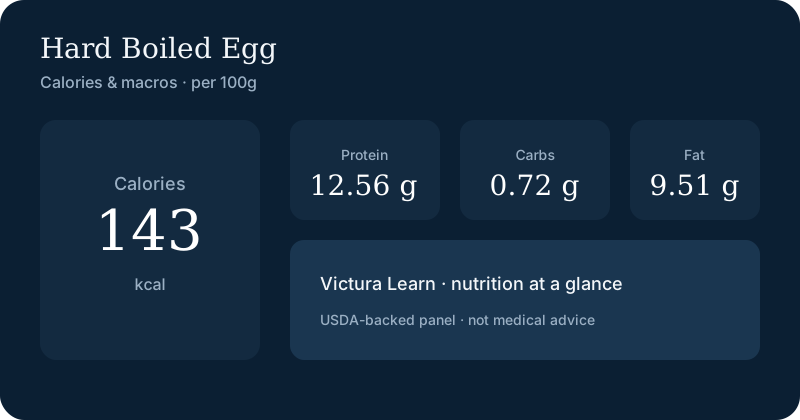
A 100g serving of hard boiled egg provides about 143 kcal. Per 100g you get about 0.72g carbs and 12.56g protein.
Hard Boiled Egg is a whole food with approximately 143 calories per 100g, tracked in Victura for macro-aware meal logging.
- Calories (100g serving)
- 143 kcal
- Carbs (100g)
- 0.72g
- Protein (100g)
- 12.56g
- Serving reference
- 100g · 100g serving
Key takeaways
- Hard Boiled Egg: 72 kcal and 6.3 g protein per large egg.
- Per 100 g: 143 kcal, 12.56 g protein, 9.51 g fat, 0.72 g carbs.
- Low-carb and keto-friendly with 0.37 g sugar and no glycemic index.
- Energy-dense, so portion control matters for weight loss.
- Good source of vitamin B12 (37% DV) and selenium (56% DV) per 100 g.

Where the calories come from
Per 100g · protein & carbs 4 kcal/g, fat 9 kcal/g
- Protein12.6 g · 36.2%
- Carbs0.7 g · 2.1%
- Fat9.5 g · 61.7%
Serving calculator
How much did you eat or drink — Hard Boiled Egg?
143
Calories
12.6g
Protein
0.7g
Carbs
9.5g
Fat
Nutrition facts
per 100g · Source: USDA FoodData Central
143 kcal
Calories
Vitamins
- Vitamin B12: 0.89mcg
Minerals
- Selenium: 30.7mcg
Scientific explanation
Research-backed🔥 Calories, Macros, and Nutrition Table
Note: Nutrition values are based on USDA FoodData Central for whole, raw, fresh egg (FDC ID 171287). Boiling causes minimal changes to macronutrients, though water loss can slightly concentrate them by weight. For precise hard-boiled values, consult USDA FoodData Central for hard-boiled eggs.
Hard Boiled Egg provides about 72 calories in one large egg (1.8 oz / 50 g), or 143 calories per 100 g (3.5 oz). The USDA FoodData Central panel for whole egg lists 12.56 g protein, 9.51 g fat, 0.72 g carbs, 0 g fiber, and 0.37 g sugar per 100 g. One large egg weighs about 1.8 oz (50 g) and is the typical serving. The table below shows values per typical serving and per 100 g.
| Nutrient | Per 1 large egg (1.8 oz / 50 g) | Per 100 g (3.5 oz) |
|---|---|---|
| Calories | 72 kcal | 143 kcal |
| Protein | 6.3 g | 12.56 g |
| Carbs | 0.4 g | 0.72 g |
| Fat | 4.8 g | 9.51 g |
| Fiber | 0 g | 0 g |
| Sugar | 0.2 g | 0.37 g |
Key takeaway: Hard boiled eggs are low-carb and high-protein, but they are energy-dense, so portion awareness matters.
💪 Protein, Vitamins, and Minerals
Hard Boiled Egg is a complete protein, supplying all nine essential amino acids. One large egg delivers about 6.3 g of protein, while 100 g provides 12.56 g. The protein in cooked eggs is highly digestible—boiling actually improves digestibility compared with raw eggs. This makes hard boiled eggs a practical protein source for snacks, salads, and meal prep.
The yolk contains most of the fat, vitamins, and minerals, while the white is mostly protein and water. The USDA panel lists 0.89 mcg vitamin B12 (37% DV) and 30.7 mcg selenium (56% DV) per 100 g. It also contains vitamin D, choline, and lutein/zeaxanthin, though these are not listed in the provided panel. The glycemic index is not applicable because hard boiled eggs contain almost no carbohydrates (0.72 g per 100 g) and only 0.37 g sugar. This means they have minimal effect on blood sugar, which can be helpful for low-carb and keto eating patterns and for people managing blood sugar.
- Complete protein with all essential amino acids
- ~6.3 g protein per large egg
- ~12.56 g protein per 100 g
- Rich in vitamin B12 and selenium
- No glycemic index; very low sugar
⚖️ Boiled vs Fried, Yolk vs White
Boiling adds no extra fat or calories. Frying typically adds oil, butter, or grease, which increases calories and fat. Hard boiled eggs are also easier to transport and less messy. For weight loss or heart health, boiled eggs are often the better choice. If you fry, use a nonstick pan with minimal oil.
- Hard boiled: no added fat, portable, easy to meal prep
- Fried: added fat and calories, crispy texture, quick to cook
- Best for weight loss: hard boiled
- Best for flavor: fried (in moderation)
Eating the whole egg gives you the full nutrient package. If you remove the yolk, you lose vitamin B12, selenium, and fat-soluble vitamins. The USDA panel values are for the whole egg, so eating only the white changes the numbers. For most people, eating the whole egg is recommended for nutrient density.

🧊 How to Boil, Store, and Serve
How long to boil eggs:
- Place eggs in a single layer in a saucepan.
- Add cold water to cover by 1 inch.
- Bring to a rolling boil over high heat.
- Cover, remove from heat, and let sit 9–12 minutes.
- Transfer to ice water for 5 minutes to stop cooking.
- Peel under running water for easier shell removal.
For a softer yolk, reduce sitting time to 6–8 minutes. For a firm yolk, use 12 minutes. Overcooking can cause a green ring around the yolk; this is harmless but may indicate longer cooking. Hard boiled eggs in the shell last about 1 week in the refrigerator. Peeled eggs last 2–3 days in an airtight container. Do not leave them at room temperature for more than 2 hours.
Serving ideas:
- Slice onto salads for extra protein.
- Mash with Greek yogurt for a lighter egg salad.
- Pair with avocado and whole-grain toast.
- Add to grain bowls or ramen.
- Make deviled eggs with mustard and paprika.
✅ Health Impact, Weight Loss, and Cholesterol
Hard boiled eggs are healthy for most people. They provide high-quality protein and key micronutrients. However, they are energy-dense at 143 kcal per 100 g, so portion control matters for weight loss. They are low in carbohydrates (0.72 g per 100 g) and have no glycemic index, making them suitable for low-carb and keto eating patterns. However, they are not a low-calorie food, so portion control is important for weight loss.
- Weight loss: eat 1–2 eggs with vegetables; track portions.
- Keto: ~0.7 g net carbs per 100 g; very keto-friendly.
- Blood sugar: 0.37 g sugar per 100 g; no glycemic index.
- Everyday: 1–2 eggs daily fits most balanced diets.
Hard boiled eggs contain dietary cholesterol, mostly in the yolk. For most people, dietary cholesterol has a smaller effect on blood cholesterol than saturated and trans fats. The 2020–2025 Dietary Guidelines for Americans removed the specific daily cholesterol limit, but people with heart disease or diabetes should follow their doctor’s advice. Boiling does not add saturated fat, unlike frying. A plain hard boiled egg has minimal sodium; adding salt increases sodium, so season with black pepper, paprika, or herbs if you are tracking sodium.
Community insights
Community insight🍽️ How the Community Eats Hard Boiled Eggs
In Victura meal logs, hard boiled eggs are a popular quick breakfast and snack. Users often pair one or two eggs with avocado, whole-grain toast, or fruit. A common meal-prep pattern is boiling a dozen eggs on Sunday and eating them throughout the week. Some users slice them into salads; others mash them with Greek yogurt for a lighter egg salad. Many report that peeling is easier when eggs are 1–2 weeks old. They store peeled eggs in an airtight container with a damp paper towel. Portions vary: some eat one egg as a snack (about 72 calories), while others eat two or three as part of a meal. Because hard boiled eggs are energy-dense, tracking portions helps with calorie goals. Users following keto appreciate the low carb count (0.72 g per 100 g).
🥚 Common Questions and Tips
- "Are hard boiled eggs good before a workout?" Many users eat one or two with a banana for pre-workout fuel.
- "Do hard boiled eggs make you gassy?" Some people notice sulfur burps if they eat many eggs, but experiences vary.
- "Can I eat hard boiled eggs every day?" Many users do, and they focus on variety in the rest of their diet.
- "How do I keep the yolk from turning green?" Users recommend an ice bath right after boiling.
- "What’s the best way to peel them?" Older eggs and peeling under running water are top tips.
- "How do you season them?" Popular choices include salt, black pepper, paprika, and everything-bagel seasoning.
🥚 Related Tools and Guides
- Calorie Calculator to estimate daily needs.
- Keto Food List for low-carb options.
- Egg Protein Guide for more on protein quality.
- Boiled Egg Calories for portion comparisons.
- Victura app to log meals and track macros.
Pros
Cons
Best time to eat
Good windows
Consider avoiding
Diet compatibility
Weight loss
Friendly
Consult your healthcare provider for personalized guidance.
Keto
Friendly
Consult your healthcare provider for personalized guidance.
Diabetes
Friendly
Consult your healthcare provider for personalized guidance.
Frequently asked questions
People also ask
Is a hard boiled egg healthy?
Yes — a hard boiled egg is a whole food with measurable nutrients. Healthiness depends on overall diet, portions, and your goals.
Can I eat a hard boiled egg every day?
Most people can include a hard boiled egg daily as part of a balanced diet, as long as total calories and carbs fit their plan.
Are Hard Boiled Eggs good for weight loss?
Hard boiled eggs can fit a calorie-controlled diet when portions are measured.
How many calories are in a hard boiled egg?
A typical medium serving of hard boiled egg has about 143 calories, while 100g contains about 143 calories (USDA reference).
Are Hard Boiled Eggs good before a workout?
Hard boiled eggs can work before activity when you want easy carbs; pair a hard boiled egg with protein if your session is long.
Are Hard Boiled Eggs high in sugar?
Hard boiled eggs contain about 0.4g sugar per 100g — mostly natural sugars when whole.
How many calories are in one hard boiled egg?
One large hard boiled egg (50 g edible portion) has about 72 calories. This is based on the USDA value of 143 kcal per 100 g. Smaller eggs have fewer calories; jumbo eggs have more.
How much protein is in a hard boiled egg?
One large hard boiled egg provides about 6.3 g of protein. Per 100 g, hard boiled egg has 12.56 g of protein. The protein is complete and highly digestible.
How long do hard boiled eggs last in the fridge?
Hard boiled eggs in the shell last about 1 week in the refrigerator. Peeled eggs last 2–3 days in an airtight container. Discard any eggs with an off smell or slimy texture.
Do hard boiled eggs lose nutrients when boiled?
Boiling causes minimal nutrient loss. Some water-soluble vitamins may leach into the water, but protein, fat, and minerals like selenium are largely retained. Cooking also improves protein digestibility.
Which is healthier, boiled or fried eggs?
Both are nutritious, but boiling adds no extra fat or calories. Frying typically adds oil or butter, increasing calories and fat. For weight loss or heart health, boiled eggs are often the better choice.
How many carbs are in a hard boiled egg?
A large hard boiled egg has about 0.4 g of carbs, and 100 g provides 0.72 g. With 0 g fiber and 0.37 g sugar per 100 g, hard boiled eggs are very low in carbohydrates and fit low-carb and keto eating patterns.
How we review this guide
- Written by
- Victura Nutrition Team
- Reviewed by
- Victura Editorial Review
- Reference sources
- 7
- Last updated
- Oct 13, 2026
References
- USDA FoodData Central: Egg, whole, raw, fresh (FDC ID 171287)(usda)
- NIH Office of Dietary Supplements: Vitamin B12(nih_ods)
- NIH Office of Dietary Supplements: Selenium(nih_ods)
- Harvard T.H. Chan School of Public Health: Eggs(harvard)
- Mayo Clinic: Eggs - Are they good or bad for my cholesterol?(mayo_clinic)
Ready to track your meals with AI?
Victura scans your plate, logs macros automatically, and coaches you toward your goals — halal, keto, diabetic-friendly, and more.