
Turkey Nutrition Facts
Calories, protein, carbs, fat, and practical serving guidance for turkey, including a USDA deli-style turkey bologna panel.
Written by Victura Nutrition TeamReviewed by Victura Editorial ReviewLast updated Nov 27, 2026
209
Calories
11.4g
Protein
4.7g
Carbs
Generally yes
Is it healthy?
per 100g · per panel values
Track this food in VicturaQuick answer
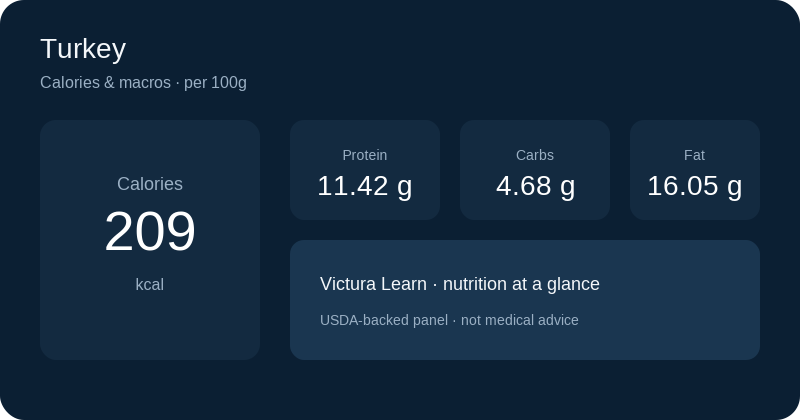
A 100g serving of turkey provides about 209 kcal. Per 100g you get about 4.68g carbs and 11.42g protein.
Turkey is a whole food with approximately 209 calories per 100g, tracked in Victura for macro-aware meal logging.
- Calories (100g serving)
- 209 kcal
- Carbs (100g)
- 4.68g
- Protein (100g)
- 11.42g
- Serving reference
- 100g · 100g serving
Key takeaways
- The USDA panel here is for turkey bologna, not lean turkey breast.
- A 2 oz (56 g) portion has about 117 calories.
- Per 100 g, turkey bologna has 209 calories and 11.42 g protein.
- At 4.68 g carbs per 100 g, turkey bologna is low in carbohydrate; portions still matter.
- For weight loss, weigh portions and choose leaner turkey cuts.

Where the calories come from
Per 100g · protein & carbs 4 kcal/g, fat 9 kcal/g
- Protein11.4 g · 21.9%
- Carbs4.7 g · 9%
- Fat16.1 g · 69.2%
Serving calculator
How much did you eat or drink — Turkey?
209
Calories
11.4g
Protein
4.7g
Carbs
16.1g
Fat
Nutrition facts
per 100g · Source: USDA FoodData Central
209 kcal
Calories
Scientific explanation
Research-backedTurkey provides protein and fat in a range that depends heavily on the cut, preparation, and processing. The USDA panel used for this page is for Bologna, turkey (FDC ID 173857), a deli-style product, so the numbers below describe that specific food—not a whole roasted turkey breast or lean ground turkey. For a typical 2 oz (56 g) sliced portion, this panel works out to about 117 calories; per 100 g (about 3.5 oz), it lists 209 calories.
🔥 Quick Answer: Turkey Calories and Serving Size
- Typical 2 oz (56 g) serving: about 117 calories, 6.4 g protein, 9.0 g fat, 2.6 g carbs, 0.3 g fiber, and 1.6 g sugar.
- Per 100 g (about 3.5 oz): 209 calories, 11.42 g protein, 16.05 g fat, 4.68 g carbs, 0.5 g fiber, and 2.9 g sugar.
- Label check: whole-muscle turkey, ground turkey, and deli turkey can differ substantially; use the exact product panel when comparing.
📊 Turkey Nutrition Table
| Nutrient | Per 56 g (2 oz) serving* | Per 100 g (about 3.5 oz) |
|---|---|---|
| Calories | 117 kcal | 209 kcal |
| Protein | 6.40 g | 11.42 g |
| Carbohydrates | 2.62 g | 4.68 g |
| Fat | 8.99 g | 16.05 g |
| Fiber | 0.28 g | 0.5 g |
| Sugar | 1.62 g | 2.9 g |
*The 56 g column is calculated from the USDA per-100 g panel and rounded. The 100 g column shows the USDA panel values as provided. A 56 g portion is about 2 oz; 100 g is about 3.5 oz.
💪 Protein, Fat, and Carbohydrates
At 11.42 g protein per 100 g (about 3.5 oz), the panel shows turkey bologna is a moderate protein food per calorie, not a high-protein lean meat. A 2 oz (56 g) serving delivers 6.4 g protein. Fat is the largest macro by calories in this panel: 16.05 g per 100 g and about 9.0 g per 2 oz. Carbohydrates are low at 4.68 g per 100 g, including 2.9 g sugar and 0.5 g fiber.
At roughly 4.2 g net carbs per 100 g (4.68 g total carbs minus 0.5 g fiber), turkey bologna can fit low-carb patterns in small portions, but portions and added ingredients still matter. For weight management, 209 kcal per 100 g is energy-dense; a 2 oz portion is more moderate at about 117 kcal.

⚖️ Turkey vs Chicken and Cut Differences
Turkey and chicken are both poultry, but nutrition depends on the cut. Skinless turkey breast, ground turkey, turkey sausage, and turkey bologna are different foods with different fat, sodium, and calorie profiles. This page’s USDA panel is for turkey bologna, so do not use it as a stand-in for roasted breast meat. For a broader poultry comparison, see chicken nutrition facts and ground turkey nutrition.
When asking “Is turkey healthier than chicken?”, the useful answer is: compare like with like. Skinless breast to skinless breast is one comparison; deli turkey bologna to chicken breast is another. The first is a lean-meat comparison, while the second mixes processed meat with fresh poultry. Check the Nutrition Facts label for the product you actually buy.
🍞 Weight Loss, Blood Sugar, and Daily Eating
For blood sugar, the panel lists no glycemic index and 2.9 g sugar per 100 g, so total carbohydrate, portion size, and the rest of the meal still matter. The panel also does not list sodium, and deli-style meats can vary widely in sodium—check the label if you are limiting salt.
For weight loss, treat turkey as a portion-aware protein. A 2 oz (56 g) serving at about 117 kcal can fit into a sandwich or salad, but stacking several servings, cheese, mayo, and bread quickly raises calories. Use a protein calculator to estimate your daily target, then choose leaner turkey cuts when you want more protein per calorie.
🥄 Practical Turkey Serving Tips
- Use 2 oz (56 g) of deli-style turkey as a starting portion for sandwiches, wraps, or salads.
- Pair turkey with high-fiber foods such as vegetables, beans, or whole-grain bread to improve fullness.
- Choose whole-muscle turkey or lean ground turkey when you want a lower-fat profile than the bologna panel shown here.
- Read labels for sodium, added sugar, and fat, especially in deli meats and seasoned ground turkey.
- For meal prep, weigh portions in grams or ounces instead of estimating by slices.
Bottom line: Turkey can fit many eating patterns, but the exact calories and macros depend on the product; use the USDA panel for deli-style turkey bologna and a product-specific label for other cuts.
Community insights
Community insight🍗 How People Actually Buy Turkey
Shoppers meet turkey in several forms: whole birds, breast fillets, ground turkey, deli slices, sausage, and bologna. Common shopper questions and Victura editorial synthesis suggest the biggest confusion is treating all of these as one food. A sandwich slice, a burger patty, and a roasted breast can have very different calories, fat, and sodium. Start with the form you eat most often, then read that label.
🥄 Meal Ideas That Keep Portions Clear
- Sandwich: 2 oz (56 g) deli turkey + whole-grain bread + tomato + mustard.
- Salad: 2 oz (56 g) sliced turkey + mixed greens + chickpeas + vinegar dressing.
- Breakfast: 1–2 oz (28–56 g) turkey bologna with eggs and fruit; check sodium.
- Meal prep: weigh 3–4 oz (85–113 g) lean ground turkey or breast and pair with vegetables.
- Snack plate: small turkey portion with cucumber, carrots, and whole-grain crackers.
🍗 Label-Reading Shortcuts
Look first at the serving size in grams and ounces, then calories, protein, fat, and sodium. Deli-style turkey can be sliced thin, so “one serving” may be fewer grams than expected. If the label lists “turkey breast” but the product is formed or processed, the nutrition can still differ from fresh breast. For weight loss, compare protein per 100 calories; for blood sugar, compare total carbohydrate and added sugar.
🍗 Community Questions We Hear
People often ask whether turkey is an everyday food, a pre-workout protein, or a weight-loss food. The practical answer is that turkey can be part of a balanced routine, but processed versions should be portioned and balanced with vegetables, whole grains, and unsaturated fats. If you eat deli turkey daily, rotate in fresh poultry, fish, beans, or eggs to diversify nutrients. Use the Victura learn hub for related food pages and the meal planner to see how portions fit your day.
Pros
Cons
Best time to eat
Good windows
Consider avoiding
Diet compatibility
Weight loss
Friendly
Consult your healthcare provider for personalized guidance.
Keto
Friendly
Consult your healthcare provider for personalized guidance.
Diabetes
Friendly
Consult your healthcare provider for personalized guidance.
Frequently asked questions
People also ask
Is a turkey healthy?
Yes — a turkey is a whole food with measurable nutrients. Healthiness depends on overall diet, portions, and your goals.
Can I eat a turkey every day?
Most people can include a turkey daily as part of a balanced diet, as long as total calories and carbs fit their plan.
Are Turkeys good for weight loss?
Turkeys can fit a calorie-controlled diet when portions are measured.
How many calories are in a turkey?
A typical medium serving of turkey has about 209 calories, while 100g contains about 209 calories (USDA reference).
Are Turkeys good before a workout?
Turkeys can work before activity when you want easy carbs; pair a turkey with protein if your session is long.
Are Turkeys high in sugar?
Turkeys contain about 2.9g sugar per 100g — mostly natural sugars when whole.
Is turkey healthy?
It depends on the form. Fresh, skinless turkey breast is a lean protein, while turkey bologna and some deli meats are higher in fat and processing. The USDA panel on this page is for turkey bologna: 209 calories, 16.05 g fat, and 11.42 g protein per 100 g (about 3.5 oz). Check sodium and ingredients on the label.
Can you eat turkey every day?
You can eat turkey daily, but variety is smart. If you eat deli-style turkey bologna every day, keep portions moderate—2 oz (56 g) is about 117 calories—and watch sodium, which is not listed in this panel. Rotate with fish, eggs, beans, and fresh poultry.
Is turkey good for weight loss?
Turkey can fit weight loss, but this panel is energy-dense: 209 calories per 100 g (3.5 oz) and about 117 calories per 2 oz (56 g). Choose leaner whole-muscle turkey or lean ground turkey more often, weigh portions, and build meals with vegetables and fiber.
How many calories are in one serving of turkey?
For the USDA turkey bologna panel used here, one 2 oz (56 g) serving has about 117 calories. Per 100 g (about 3.5 oz), it has 209 calories. Fresh turkey breast, ground turkey, and other deli products have different calorie counts, so check the specific label.
Is turkey good before a workout?
Turkey can work before a workout if the meal is easy to digest and includes carbohydrate. A small portion—1–2 oz (28–56 g) of turkey with fruit, bread, or rice—may suit some people. Very high-fat deli products like bologna can feel heavy before exercise; choose leaner turkey or allow more digestion time.
Is turkey high in sugar?
The USDA panel lists 2.9 g sugar per 100 g (3.5 oz) and about 1.6 g per 2 oz (56 g), which is not high by itself. Glazed turkey, cranberry sauce, sweet marinades, and some deli products can add more sugar—check the label.
How we review this guide
- Written by
- Victura Nutrition Team
- Reviewed by
- Victura Editorial Review
- Reference sources
- 5
- Last updated
- Nov 27, 2026
References
Ready to track your meals with AI?
Victura scans your plate, logs macros automatically, and coaches you toward your goals — halal, keto, diabetic-friendly, and more.